Author Archives: bwisnewski

Solid Brick vs. Brick Veneer

Solid Brick vs. Brick Veneer

by Nick Gromicko and Rob London

Brick house

Solid brick and brick veneer structures use some of the same construction materials, but their installation techniques are different.

Solid brick houses (also known as double-brick and solid masonry houses) are built from either two layers of brick, or a layer of concrete block and an adjacent layer of brick on the exterior. The brick is part of the building’s structural support system; if the brick were removed, the building would suffer structural failures.

Brick veneer is not, contrary to popular belief, composed of thin pieces of brick, such as is found in veneer floors, patios, and decorative interior elements. Brick veneer houses look almost identical to solid brick structures, except that they are built using a very different technique. The house itself is constructed from steel or wooden framing, and then covered with wood sheathing or insulation. A single layer of brick is built near each exterior wall and attached to the house with metal ties. Veneer brick does not support the structural load of the building; if the brick were removed, the house would continue to stand.

Installation

Solid brick and brick veneer both use the same bricks, although each style becomes defined during installation. Inspectors can use the presence of the following elements as evidence that a wall is solid brick rather than veneer:Header bricks in a solid brick wall
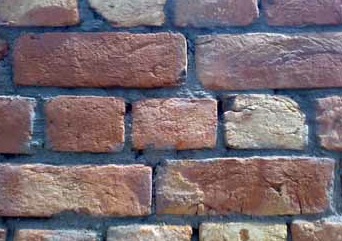
  • header bricks. These bricks appear smaller than the other bricks, but they are actually the same size; laid sideways, only the short end is visible. The header bricks act as a bridge between the outer wythe (layer) and the inner wythe, and prevent the two from separating, which is especially important as the wall increases in height. Header bricks are found in every sixth row in many solid masonry configurations, although other configurations are possible. On occasion, metal ties are used to hold wythes together and, in this case, no header bricks may have been required, allowing the wall to appear like a veneer.
  • reinforced arches. Surrounding windows in solid brick houses, there will be reinforced arches with blocks that face in toward the house to reinforce the opening.
  • older brick houses (older than 30 years) are much more likely to be solid brick than brick veneer.

Brick veneer, unlike solid brick, can be installed any time after building construction has been completed. The home’s exterior sheathing is covered with special paper to protect it against moisture and wire ties are attached at intervals, per building codes. The bricks are all laid horizontally (no header bricks) and are located several inches to a foot from the home. Weep holes are used to allow the space between the brick and frame walls to breathe and to permit accumulated moisture in this area to escape. Unfortunately, weep holes are often clogged by mortar as a result of the construction process. Clogged weep holes will allow moisture to accumulate behind the bricks, leading to decay that attracts pest infestation. Special vents can be installed in the veneer surface to relieve this problem, although many people consider them unsightly.

Benefits of Solid Brick

  • Solid brick is much more stable in the event of an earthquake or heavy winds. Solid brick houses are resilient and may last centuries.
  • Because there is no interior wood framing system, termites and decay are not an issue.

Benefits of Brick Veneer

Builders specifically choose brick veneer for the following functional and stylistic qualities:

  • It is relatively easy to install, since there is only one layer of masonry.
  • It is generally more affordable.
  • It requires a relatively simple foundation and support system. Solid brick homes, by contrast, are very heavy, and require substantial footing and foundation systems.
  • The air cavity between the brick and the home helps to keep moisture out of the home and acts as an effective insulating space, especially if it is filled with insulation. Solid brick walls are poor insulators, and also may allow moisture to penetrate exterior walls and cause problems in the home. Note that the house wrap beneath veneer may leak during heavy rain, perhaps due to the holes that are placed in the wrap during installation.
  • Like solid brick, veneer is durable and fireproof, it looks fancy, and it requires little maintenance and no paint or stain.

In summary, solid brick and brick veneer homes use many identical building materials, although they differ by their methods of installation. 

Bob Wisnewski on Zillow


Shrinkage Cracks in Concrete

Shrinkage Cracks in Concrete

by Nick Gromicko and Kenton Shepard, InterNACHI’s Director of Green Building

Newly-placed concrete develops tensile stresses as differences in temperature and moisture content develop in the drying concrete. These stresses are relieved by cracking. A number of factors can influence the development of such stresses.

Control of Crack Locations

Control joints are sometimes installed in an attempt to determine the areas at which concrete will crack. Control joints are grooves pressed into the concrete during the finishing process. Because the concrete slab is thinner and weaker at these grooved areas, it tends to develop cracks in these grooves first.

Because of the many factors which can influence the locations at which cracks develop, they sometimes appear in areas other than at control joints.

Restraint to Shrinkage

According to the Portland Cement Association, restraint to shrinkage is the most common cause of concrete cracking. This condition is inherent in continuously-poured concrete slabs.  In applications such as concrete slabs and residential foundation walls, cracking is inevitable and expected.

As the surface of concrete dries, water evaporates from the spaces between particles. As this water dissipates, the particles move closer together, resulting in shrinkage of the concrete. Because the surface of a concrete slab is exposed to air but the underlying concrete is not, concrete near the surface dries and shrinks at a rate different from that of the underlying concrete. The underlying concrete acts as a restraint to shrinkage, resulting in cracking of the surface layer.

Factors Influencing Locations of Crack Development
  • Thermal cracking:
    Temperature differences can contribute to the development of cracks.
    The chemical hydration process through which concrete hardens produces heat which causes concrete to expand. At the same time, concrete at the surface of the slab is exposed to air and loses water through evaporation. Both of these conditions contribute to cooling and shrinking of the concrete near the surface.The hot, expanding underlying concrete acts as a restraint to shrinkage of the cooling, shrinking surface concrete. This condition produces tensile stresses which are relieved by cracking of concrete near the surface.
  • Plastic cracking:
    Water may sometimes evaporate from the surface concrete faster than moisture can migrate from the underlying concrete to replace it. When this happens, surface concrete will dry more quickly than underlying concrete. The resulting differences in moisture content produce tensile stresses which are relieved by cracking of concrete near the surface.
  • Shrinkage cracking:
    When concrete is mixed, more water than is needed for hydration is mixed with the dry components, such as sand, cement and an aggregate. Most of the water will eventually evaporate, causing shrinkage of the concrete slab.Since water evaporates from the surface, which is exposed to air, at a rate different from the underlying concrete, this differential shrinkage rate produces tensile stresses which are relieved by cracking of concrete near the surface.

Identifying Shrinkage Cracks

The following are visual clues which help to differentiate shrinkage cracks from other types of cracks which can appear in concrete slabs and foundation walls.

  • Vertical displacement:
    Cracks which are caused by soil settlement or heaving typically exhibit vertical displacement of the concrete; concrete on one side of the crack will be higher than concrete on the other side.
  • Linear crack continuity:
    Cracks caused by shrinkage are typically not linearly continuous. Although they make look continuous at first, if viewed closely, interruptions in the crack line can be seen.
  • Continuity through the slab:
    Shrinkage cracks are not continuous through the slab, but are actually cracks in the concrete surface.
  • Corrosion:
    When reinforcement steel is placed too near the surface, it can corrode. Expansion results as steel is converted to iron oxide through corrosion. This expansion can crack the concrete surface. When the crack is caused by corroding steel, corrosion is typically visible at the slab surface.
  • Alkali-aggregate reaction:
    Alkali-aggregate reaction is deterioration resulting from the reaction of an aggregate with alkali hydroxides in the concrete. Indications of this type of deterioration may be a network of cracks, closed or spalling joints, or displacement of different portions of a structure.
Bob Wisnewski on Zillow

TPR Valves and Discharge Piping

TPR Valves and Discharge Piping

by Nick Gromicko, Rob London and Kenton Shepard

TPR (temperature pressure relief) valves are safety devices installed on water heating appliances such as boilers and domestic water supply heaters. TPRs are designed to automatically release water in the event that pressure or temperature in the water tank exceeds safe levels.

If temperature sensors and safety devices such as TPRs malfunction, water in the system may become superheated (exceed the boiling point). Once the tank ruptures and water is exposed to the atmosphere, it will expand into steam almost instantly and occupy approximately 1,600 times its original volume. This process can propel a heating tank like a rocket through multiple floors, causing personal injury and extensive property damage.

Water-heating appliance explosions are rare due to the fact that they require a simultaneous combination of unusual conditions and failure of redundant safety components. These conditions only result from extreme negligence and the use of outdated or malfunctioning equipment.

The TPR valve will activate if either water temperature (measured in degrees Fahrenheit) or pressure (measured in pounds per square inch [PSI]) exceed safe levels. The valve should be connected to a discharge pipe (also called a drain line) that runs down the length of the water heater tank. This pipe is responsible for routing hot water released from the TPR to a proper discharge location.

It is critical that discharge pipes meet the following requirements, which can be found in InterNACHI’s Water Heater Discharge Piping mini-course, at www.nachi.org/education. A discharge pipe should:

  1. be constructed of an approved material, such as CPVC, copper, polyethylene, galvanized steel, polypropylene, or stainless steel. PVC and other non-approved plastics should not be used since they can easily melt.
  2. not be smaller than the diameter of the outlet of the valve it serves (usually no smaller than 3/4″).
  3. not reduce in size from the valve to the air gap (point of discharge).
  4. be as short and as straight as possible so as to avoid undue stress on the valve.
  5. be installed so as to drain by flow of gravity.
  6. not be trapped, since standing water may become contaminated and backflow into the potable water.
  7. discharge to a floor drain, to an indirect waste receptor, or to the outdoors.
  8. not be directly connected to the drainage system to prevent backflow of potentially contaminating the potable water.
  9. discharge through a visible air gap in the same room as the water-heating appliance.
  10. be first piped to an indirect waste receptor such as a bucket through an air gap located in a heated area when discharging to the outdoors in areas subject to freezing, since freezing water could block the pipe.
  11. not terminate more than 6 inches (152 mm) above the floor or waste receptor.
  12. discharge in a manner that could not cause scalding.
  13. discharge in a manner that could not cause structural or property damage.
  14. discharge to a termination point that is readily observable by occupants, because discharge indicates that something is wrong, and to prevent unobserved termination capping.
  15. be piped independently of other equipment drains, water heater pans, or relief valve discharge piping to the point of discharge.
  16. not have valves anywhere.
  17. not have tee fittings.
  18. not have a threaded connection at the end of the pipe so as to avoid capping.
Leakage and Activation

A properly functioning TPR valve will eject a powerful jet of hot water from the discharge pipe when fully activated, not a gentle leak. A leaky TPR valve is an indication that it needs to be replaced. In the rare case that the TPR valve does activate, the homeowner should immediately shut off the water and contact a qualified plumber for assistance and repair.

Inspectors should recommend that homeowners test TPR valves monthly, although inspectors should never do this themselves. The inspector should demonstrate to the homeowner how the main water supply can be shut off, and explain that it can be located at the home’s main water supply valve, or at the water supply shut-off for the appliance on which the TPR is mounted

TPR Data Plate Information

  • The pressure at which a TPR valve will activate is printed on a data plate located beneath the test lever. This amount should not exceed the working pressure limit marked on the data plate of the water-heating appliance it serves.
  • The BTU/HR rating marked on the water-heating appliance data plate should not exceed that of the TPR, which is marked on the TPR data plate.
  • TPR valves with missing data plates should be replaced.

Although a TPR valve might never become activated, it is an essential safety component on boilers and domestic water heaters. Guidelines concerning these valves and their discharge pipes reflect real hazards that every homeowner should take seriously. 


Bob Wisnewski on Zillow


To Buy or to Rent?

To Buy or to Rent?

by Nick Gromicko and Rob London

In many places where real estate advice is offered, from the Internet to advice columns and late-night infomercials, listeners and readers are told some variation of:  “Across every income bracket, homeowners are rich and renters are poor.” And, on the whole, this is true; examine the captioned chart, which summarizes findings from the Federal Reserve Board. But does homeownership cause people to be rich? It would be nice if the key to wealth were so clear, but it’s just as likely that buying houses is just something that wealthy people do, and buying houses didn’t create wealth. Unfortunately, this distinction is largely glossed over or ignored by those with a vested interest in getting people to buy homes, or who are simply blinded by the homeownership craze.

Annual Income
Owners’ Worth
Renters‘ Worth
$80,000+
$451,200
$87,400
$50,000 – $79,999
$194,610
$25,000
$30,000 – $49,000
$126,500
$10,600
$16,000 – $29,999
$112,600
$4,200
under $16,000
$73,000
$500

Wealth is often built by investment, and prospective homeowners should compare the investment opportunities gained and lost when they purchase a home. A homeowner may bag a healthy profit if the property appreciates sharply, but s/he loses the option to redirect the funds for the down payment and hidden costs to other forms of investment, such as a mutual fund or starting a business. Just make sure that you choose an investment that you’ll enjoy, as you won’t “wake up in the middle of the night and say ‘Wow! Look at my tax deduction!'” as Lewis Wallensky told The Wall Street Journal.

Obviously, there are advantages to homeownership, as homeowners get to write off mortgage interest while building equity. And, with any luck, these homeowners may be eligible for a significant tax break if they eventually sell. Homeowners also enjoy liberation from constraints that plague renters, such as the constant fear that they’ll lose their deposit every time they hammer a nail or repaint a wall. And monthly mortgage payments are gradually earning homeowners a valuable asset, rather than the equivalent of setting their savings ablaze on the first of every month. But, rest assured; that blaze will burn on into homeownership, only with less predictability.  A leaky roof or broken water heater can set a homeowner back thousands of dollars, and even foreseeable expenses, such as property taxes and insurance, will decrease their net worth in the same fashion as a rent check. And, if the homeowner doesn’t pay his mortgage, property taxes, insurance, or HOA fees, he can be foreclosed on and potentially lose everything. Renters can be forced onto the street, too, but at least they don’t lose much more in addition to their home.  

Then there’s a geographical component to the balance between the cost-effectiveness of homeownership versus renting. Minneapolis tops the list of markets that offer the best bargains for prospective homeowners, followed by cities hard-hit by the foreclosure crisis, such as Miami, Fresno, Mesa, Jacksonville, Phoenix and Las Vegas. In New York City, though, you’re better off paying the landlord than the bank. Other such cities include Portland (Oregon), Seattle, San Diego, San Francisco, Oklahoma City, Kansas City (Missouri), Cleveland, Omaha and Dallas.

Experts advise that you should buy a home if you plan to stay there for a long time and you can afford a large down payment. Real estate appreciates over the long-term, although it might dip slightly after purchase. If you can ride out that dip, you won’t be forced to sell and take a loss. A home inspection performed by an InterNACHI inspector will identify hidden defects and illuminate the risks of a prospective property purchase. Also, you get a better interest rate and you won’t have to purchase mortgage insurance if you put 20% down. But if you don’t have the funds to put down 10%, or you plan to leave in a few years, and a slump in house prices seems likely, you should reconsider homeownership. Also, you should expect to pay around 30% of your monthly income on your mortgage.  If you’ll be paying more than half your income toward your mortgage, you should probably stick to renting.

In summary, buying and renting both afford unique investment opportunities, headaches and perks.

Bob Wisnewski on Zillow


The Small House Movement

The Small House Movement

by Nick Gromicko and Rob London

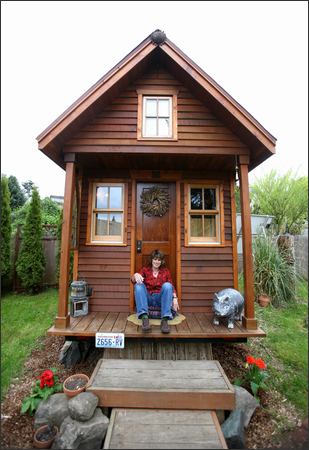
A growing number of homeowners in the U.S. are downsizing to homes smaller than 1,000 square feet, and, in some cases, smaller than 100 square feet. This transition to smaller homes, known as the Small House Movement, is adhered to by people who believe American houses in general are too large, wasteful and energy-inefficient.Small houses are becoming more common

While home sizes ballooned from the 1950s into the early 2000s, data suggests that this trend is slowing, or even reversing. A 2008 survey shows that more than 60% of potential home buyers would rather have a smaller house with more amenities than the other way around. Similarly, according to the National Association of Home Builders, 59% of builders nationwide said they were planning to or were already significantly downscaling from the “McMansion” era.

The disadvantages of downsizing are obvious:  you may have to get rid a lot of furniture, the new house is less prestigious, and you lose space for guests. Neighbors, too, might view your small home as a threat to their property values. But living small is nothing new.  After World War II, 1,000-square-foot homes were the norm for returning soldiers and their families.

Gayle Butler, editor-in-chief of Better Homes and Gardens, describes the Small House Movement as “right-sizing,” rather than downsizing, as homeowners forgo unused space and buy homes that better fit their needs. Dee Williams, of Olympia, Washington, sold her 1,500-square-foot home and moved into an 84-square-foot home that she built herself. When the electric company began charging more for electricity, her bill doubled from $4 to $8, an increase that probably would have been more dramatic in her previous home.

Adherents to the Small House Movement enjoy the following perks of their transition:

  • increased cash flow. Smaller homes require a smaller mortgage, lower property taxes, and decreased homeowner’s insurance, maintenance costs, and the expense required to furnish the home. Owners might even be able to purchase a smaller house in cash using the proceeds from their existing home. And with the extra money, they can afford improved insulation, higher-quality windows and flooring, and luxuries such as solar roof panels and skylights;
  • less maintenance. Fewer rooms and smaller spaces cut down on the time needed to clean and maintain, leaving more hours in the day for more enjoyable activities;
  • lower utility bills. It costs a lot less to heat and cool a small home than a large home. Typically, there is no wasted space in vaults in a small home;
  • reduced consumption. If there is little space to store items, homeowners are much less likely to buy new things. Fewer rooms and windows mean less money spent on TVs and curtains, for instance;
  • more time with family. Less space means that more room must be shared, which encourages group activities and dinners.
While the benefits of the Small House Movement are clear, the transition isn’t easy for everyone, especially for those who have become accustomed to large houses. The following tips can help homeowners make do with less space:
  • Use items for more than one purpose. For example, you can use a trunk as a coffee table, placing in it items such as shoes, files, and extra sheets to save closet space.
  • Eliminate or cut down on extra silverware, pots, pans and dishes if the kids have moved out.
  • Use rooms for more than one purpose. You may be able to squeeze a small computer desk into the corner of a bedroom, and a rarely-used dining room can double as a library.
  • Purchase a stackable washer/dryer unit to save space.

In summary, median house sizes have begun to decline, spurred on by adherents to the Small House Movement.

Bob Wisnewski on Zillow