Author Archives: bwisnewski

Termite Control in the Home

Termite Control in the Home

by Nick Gromicko and Elise London
Wood-destroying insects and other organisms can cause serious problems in the wooden structural components of a house, and may go undetected for a long period of time.
 
New Construction
All chemical soil treatments, bait systems, and chemical wood treatment must be approved by the Environmental Protection Agency (EPA) and applied in accordance with the EPA label’s instructions. In some cases, it is not feasible for a builder to arrange for soil treatment. In this regard, the International Residential Code (IRC) by the International Code Council allows a builder to utilize pressure-treated wood as a measure of termite protection. If pressure-treated wood is used, however, it must be used in all framing members up to and including the top plate of the first floor’s level wall. This includes the sub-floor and floor joists of the first floor. The use of pressure-treated wood in only the sill plate is not acceptable. In such cases, the builder must provide the lender with a letter stating that the house is protected from termites by the use of pressure-treated wood. The builder must also provide the home buyer with a one-year warranty against termites. The use of post-construction soil treatment where the chemicals are applied only around the perimeter of the foundation is NOT acceptable in new construction.
 
Appraiser’s Observations
 
Appraisers are to observe all areas of the house and other structures/areas within the legal boundaries of the property that have potential for infestation by termites and other wood-destroying organisms, including the bottoms of exterior doors and frames, wood siding in contact with the ground, and crawlspaces. Mud tunnels running from the ground up the side of the house may indicate termite infestation. Observe the eaves and gable vents and wood window sills for indication of the entrance of swarming termites, and note excessive dampness or large areas where the vegetation is dead. Evidence of active termite infestation must be noted.
 
Termites
 
Subterranean termites are the most damaging insects of wood. Their presence is hard to notice, and damage usually is found before the termites are seen. Prevent infestations because if they occur, they will almost always need professional pest-control service.
 
Signs of Infestation
 
Hire a qualified InterNACHI inspector to inspect for termites or other wood-destroying organisms. Generally, the first sign of infestation is the presence of swarming termites on the window or near indoor light. If they are found inside the house, it almost always means that they have infested. Other signs that may be found are termite wings on window sills or in cobwebs, and shelter tubes, which are tunnels constructed by the termites from soil or wood and debris. Usually, wood damage is not found at first, but when it is found, it definitely reveals a termite infestation. Anywhere wood touches soil is a possible entry into a home for termites. Examine wood which sounds dull or hollow when struck by a screwdriver or hammer. Inspect suspected areas with a sharp, pointed tool, such as an ice pick, to find termite galleries or their damage.
 
Control
 
Control measures include reducing the potential infestation, preventing termite entry, and applying chemicals for remedial treatment.
 
 
Inspect thoroughly to determine if there is an infestation, damage, and/or conditions that could invite a termite attack, or the need for remedial control measures. The tools and equipment needed for an inspection include a flashlight, ice pick or sharp-pointed screwdriver, ladder, and protective clothing. Always hire an InterNACHI inspector for your inspection needs, as they are trained by the highest standards in the inspection industry.
 
Outdoors
 
Check the foundation of the house, garage and other buildings for shelter tubes coming from the soil. Look closely around porches, connecting patios, sidewalks, areas near kitchens and bathrooms, and hard-to-see places. Check window and door frames, and where utility services enter the house for termite infestation or wood decay. Also, look behind shrubbery and plants near walls. Pay special attention to areas where earth and wood meet, such as fences, stair carriages and trellises. Open and check any exterior electrical meter or fuse box set into the wall, a common point of infestation.
 
Indoors
 
Carefully check all doors, window facings, baseboards, and hardwood flooring. Discoloration or stains on walls or ceilings may mean that water is leaking and can decay wood, and this can aid termite infestation. It is very important to inspect where plumbing and utility pipes enter the foundation and flooring. Also, examine the attic for shelter tubes, water leakage, and wood damage.
.
 Prevention Many termite problems can be prevented. The most important thing to do is to deny termites access to food (wood), moisture and shelter. Follow these suggestions:

  • have at least a 2-inch clearance between the house and planter boxes, or soil-filled porches;
  • eliminate all wood-to-soil contact, such as trellises, fence posts, stair casings and door facings (they can be put on masonry blocks or on treated wood);
  • separate shrubbery from the house to help make it easier to inspect the foundation line;
  • use wolmanized wood (pressure-treated wood) so that rain will not rot it;
  • seal openings through the foundation;
  • remove wood scraps and stumps from around the foundation;
  • have at least 12 to 18 inches of clearance between floor beams and the soil underneath.
 
Chemical Treatment
 
Termite treatment often requires specialized equipment. Therefore, it is recommended that you always use the services of a pest control operator because he is familiar with construction principles and practices, has the necessary equipment, and knows about subterranean termites.
 
Exterminating TermitesIf you think you have a termite infestation in your house, you need to call a structural pest control company to conduct a professional inspection. To find a company, ask friends or coworkers for recommendations, or check the Yellow Pages. If the inspection finds evidence of drywood termites, you have several options, depending on the degree of infestation. Fumigation and heating of the entire house are the only options that ensure eradication in the entire structure. If the infestation is contained in a small area, local or spot control may be effective. However, hidden infestations in other parts of the structure will not be eradicated.
 
Total (Whole-House) Eradication 
 
For the heat method, pets, plants, and other items that might be damaged by high temperatures must be removed. The house is then covered with tarps, and hot air is blown into the tarp until the inside temperature reaches 140° F to 150° F, and the temperature of the structural timbers reaches 120° F. The time to complete this procedure varies greatly from one structure to another, depending on factors such as the building’s construction and the weather conditions. The procedure may not be practical for structures that cannot be heated evenly.
 
Local or Spot Control
 
Local or spot-control methods include the use of pesticides, electric current, extreme cold, localized heat, microwave energy, or any combination of these methods. Local or spot control also includes the removal and replacement of infested structural timber. These methods are intended to remove or kill termites only within the specific targeted area, leaving open the possibility of other undetected infestations within the structure. These treatments are NOT designed for whole-house eradication. Any pest control company that claims whole-house results with local or spot control methods is guilty of false advertising and should be reported.
 
Local or spot treatment with pesticides involves drilling and injecting pesticides into infested timbers, as well as the topical application of toxic chemicals. The electric-current method involves delivering electric energy to targeted infestations. For the extreme cold method, liquid nitrogen is pumped into wall voids adjacent to suspected infestation sites, reducing the area to -20° F. The localized heat method involves heating infested structural timbers to 120° F. The microwave method kills termites by directing microwaves into termite-infested wood.
 
If you see the following signs in your house, you might have termites:
 
• sawdust-like droppings;
• dirt or mud-like tubes or trails on the structure;
• damaged wood members (like window sills); and
• swarming winged insects within the structure, especially in the spring or fall.


Cockroach Inspection

Cockroach Inspection

by Nick Gromicko and Rob London
Cockroaches are one of the most commonly encountered household pests. Homeowners and inspectors can learn about ways to eliminate these insects and the conditions that encourage their infestation.
Cockroach infestation is a common household problem

Cockroaches have a broad, flattened body and a relatively small head that covers their mandibles and other mouthparts. They have six legs, large ocelli (simple eyes), and a pair of long, flexible antennae. Although winged, they are not adept fliers. The best-known varieties are the American cockroach (1.2 inches long), the German and Asian cockroaches (0.59 inches long), the Oriental cockroach (0.98 inches long), and the brown-banded cockroach (0.55 inches long).

Facts and Figures

  • The world’s heaviest cockroach is the Australian giant burrowing cockroach, which can weigh more than 30 grams and reach 3½ inches in length.
  • While cockroaches could withstand six to 15 times as much radiation exposure as humans, the popular belief that they will “inherit the Earth” in the wake of nuclear war is largely undeserved; other insects, such as fruit flies, have even better resistance against radiation than cockroaches.
  • While it has been known for some time that cockroaches and termites are related, it wasn’t until 2007 that it was proven that termites are a kind of “social cockroach,” having actually evolved from cockroaches. Similarities include specialized casings that enclose their eggs, perforations in the internal parts of their heads, and similarities among their young. There are significant differences between these pests, however; termites pose a greater danger to wood, and they form huge, complex societies, while cockroaches are solitary, generalized insects with few special adaptations.
  • Some species of cockroaches can survive for months without food and subsist on nothing but the glue on the back of a postage stamp, and even their own feces. Experiments have revealed that they can go without air for 45 minutes and recover after being submerged under water for half an hour.
  • Cockroaches are prolific breeders and can produce several thousand offspring in a year, once they become established in a home. They are normally introduced on clothing, shopping bags and furniture, and they can also simply wander in from the outdoors.

Cockroaches are known to spread diseases such as salmonella, food poisoning and dysentery, primarily through contact with their feces and defensive secretions. They also transport dangerous microbes, a particular problem in hospitals. Their skin, which is discarded through periodic molting, can become airborne and trigger severe asthmatic reactions in prone individuals. Incredibly, cockroaches have even been found to be second only to house dust as the worst allergen affecting people, according to the University of Kentucky’s College of Agriculture. Besides these physical ailments, cockroaches emit an unpleasant odor during swarming and mating, and they can keep a building’s occupants awake at night with their incessant hissing and, in the case of some cockroach species, chirping.

InterNACHI inspectors should not be surprised to find evidence of cockroaches in messy buildings, as the insects thrive in dirty environmenCommon household cockroachests. No buildings are completely immune to cockroach infestation, however, as they will be attracted to even the smallest amounts of food deposits. They prefer to feed on decaying grease, sugar and other organic matter, as well as inanimate, starchy food sources such as glue, wallpaper and even book bindings. Pepper-like specs in kitchen cupboards are an indication of cockroach infestation, as is the observation of adult cockroaches or their egg sacs in hard-to-reach locations, such as cracks and crevices in kitchen cabinets, drains, and behind dishwashers and refrigerators. The entire kitchen area should be inspected, especially under sinks, in cabinet hinge areas, drawers, refrigeration gaskets, dishwashers, stoves and other cooking appliances. Also check crawlspaces, bathrooms and other dark, moist areas where food sources may be present.
Tips that inspectors can pass on to homeowners:

  • Place boric acid in areas of cockroach activity. Boric acid can maintain an infestation once under control, but pyrethrin should be used first and the whole structure bug-bombed.
  • Pyrethrin should be used first, and after the population is under control place boric acid wherever needed.
  • Place bait stations containing hydramethylnon or fipronil in areas of termite activity. At night, homeowners can sneak into the kitchen and turn on the lights. If cockroaches scurry for cover, observe where they run and position traps accordingly.
  • Keep all food in sealed containers, use trash cans that have tight-fitting lids, and do not leave pet food out overnight.
  • Clean the kitchen regularly, and wipe moisture from the kitchen sink before going to bed at night.
  • Vacuum frequently.
  • Repair dripping taps and leaky pipes, broken roof tiles, and any other condition that might allow moisture to enter areas where cockroaches can establish harborage.
  • Seal off all entry points into the house, such as cracks around baseboards, pipes, windows, cabinets, doors and crevices in bathrooms with copper mesh or steel wool and caulk or putty.
  • Keep lights on at night. Although it will consume additional electricity, cockroaches will avoid lit areas. For the same reason, restaurant owners sometimes leave lights on around dumpsters.
  • If cockroach infestation persists, contact a qualified exterminator.
In summary, cockroaches are hardy, disease-carrying household pests that can be controlled by maintaining a clean home and eliminating sources of moisture intrusion.

Ant Inspection

Ant Inspection

by Nick Gromicko and Rob London
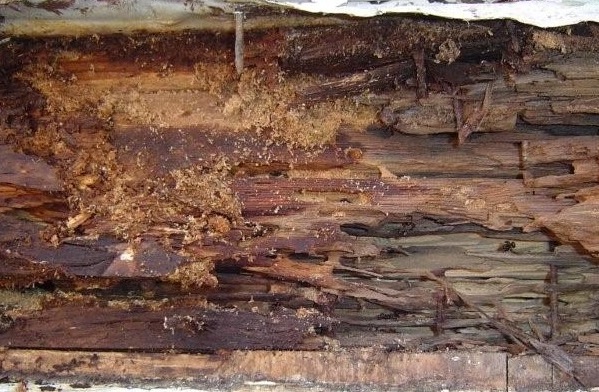
Ants are among the most prevalent pests in households, restaurants, hospitals, offices, warehouses, and virtually all buildings where food and water can be found. While mostly harmless to humans, ants (especially carpenter ants) can cause considerable building damage.Ant damage due to galleries  Inspectors can expand their knowledge base by being able to identify some of the telltale signs of ant infestation.
Ant Behavior
Ants are social insects that live in colonies divided into three castes: queens, males and workers. Most of the ants you may observe, which are responsible for gathering food, are sterile female workers. Winged males and females will leave the nest to mate, and to find suitable locations for new colonies. After mating, the males die and the impregnated females (queens) shed their wings and lay eggs that will hatch into the legless, grub-like larvae. The queen takes care of these larvae as they develop until they finally become pupae. Within a few weeks, adult worker ants emerge from these pupae and take over the job of tending the young.

Distinguishing Ants from Termites

Winged ants are often mistaken for winged termites, which also leave their nests to mate. These insects can be distinguished from one another by three main characteristics:

  • The ant’s body is constricted, giving it the appearance of having a thin waist, while the termite’s body is not constricted.
  • The ant’s hind wings are smaller than its front wings, while the termite’s front and hind wings are about the same size. Wings might not always be present, however, as both species eventually lose them. Ants and termites are different in three key ways
  • Winged female and worker ants have elbowed antennae, while the termite’s antennae are not elbowed.

Termites and ants both construct nests in moist wood, but ant nests are typically smoother and lack mud structures commonly found in termite nests. Also, termites actually subsist on wood, so the structural damage they leave it their wake is generally more severe than that caused by ants, which merely tunnel through wood.

Nests

Carpenter ants nest in both moist and dry wood, but they prefer moist wood. Accordingly, nests are more likely to be found in wood dampened by water leaks, such as wood around bathtubs and sinks, poorly sealed windows and door frames, roof leaks and poorly flashed chimneys. Nests are especially common in moist, hollow spaces, such as the wall void behind a dishwasher and in a hollow deck column. As there will often be no external signs of damage, probing the wood with a screwdriver helps reveal the excavated “galleries.” Another technique for locating hidden nests is to tap along baseboards and other wood surfaces with the blunt end of a screwdriver while listening for the hollow sound of tunneled wood. If a nest is nearby, carpenter ants often will respond by making a rustling sound within the nest.

Inspection

The following clues are evidence that a building is host to an ant infestation:

  • long trails of ants, perhaps numbering in the hundreds or thousands. Ants assemble in long trails along structural elements, such as wires and pipes, and frequently use them to enter and travel within a structure to their destination. Follow the trail to locate their nest or their entry point, such as an electrical outlet, or gap along a baseboard or around a water pipe;Ants entering, or exiting, a lightswitch
  • a few straggler ants. These are scouts in search of food and nesting sites. They, too, may be followed back to the nest to betray their family;
  • holes or cracks in walls or foundations, especially where pipes enter the building, and around windows and doors. These can provide entry points for ants and other insects. Kitchens are other food storage and preparation areas are particular problem areas;
  • frass deposits. Frass is the fine sawdust produced after galleries are carved out of the wood. If you suspect that a piece of woodwork hosts a gallery, you can tap on it with a screwdriver tip and see if any dust falls away;
  • a distinctive rustling sound similar to the crinkling of cellophane. Ants are small, but nests are large enough to produce perceptible noise; and
  • outside, inspect for nests in mulch and vegetation next to the foundation. Check under potted plants, patio blocks, stepping stones, in piles of rocks, lumber and firewood.
Exclusion Practices
A number of steps can be taken by homeowners to reduce the potential for future ant problems, such as:
  • Store food items that attract ants, such as sugar, syrup, honey, and pet food in closed containers. Wash them to remove residues from outer surfaces.
  • Rinse out empty soft drink containers or remove them from the building.
  • Thoroughly clean up grease and spills.
  • Remove garbage from buildings daily and change liners frequently.
  • Correct roof and plumbing leaks and other moisture problems that will attract ants.
  • Eliminate wood-to-ground contact, such as where landscaping has pushed soil or mulch up against the wood siding of a home.
  • Clip back tree limbs and vegetation touching the roof or siding of the house. Limbs and branches serve as bridges between tree limb nests and the structure.
  • Seal cracks and openings in the foundation, especially where utility pipes and wires enter from the outside.
  • Stack firewood away from the foundation, and elevate it off the ground. Never store firewood in the garage or other areas of the home, as firewood is a major ant nesting area.
In summary, ants are complex creatures that create structural defects in buildings. Inspection and exclusion techniques should be practiced.
 

Knob-and-Tube Wiring

Knob-and-Tube Wiring

by Nick Gromicko, Rob London and Kenton Shepard
 
Knob-and-tube (K&T) wiring was an early standardized method of electrical wiring in buildings, in common use in North America from about 1880 to the 1940s. The system is considered obsolete and can be a safety hazard, although some of the fear associated with it is undeserved.

InterNACHI inspectors should always disclaim knob-and-tube wiring during their inspections.

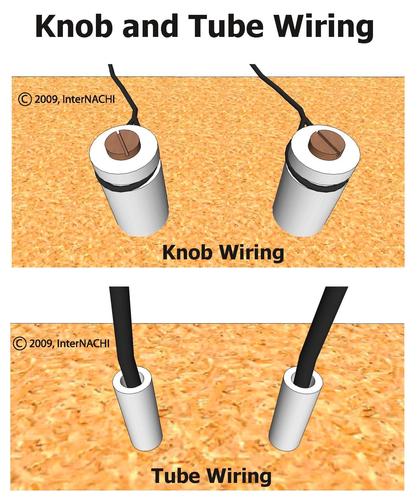
Facts About Knob-and-Tube Wiring:Knob and Tube Wiring

  • It is not inherently dangerous. The dangers from this system arise from its age, improper modifications, and situations where building insulation envelops the wires.
  • It has no ground wire and thus cannot service any three-pronged appliances.
  • While it is considered obsolete, there is no code that requires its complete removal.
  • It is treated differently in different jurisdictions. In some areas, it must be removed at all accessible locations, while others merely require that it not be installed in new construction. Inspectors should be sure to know the codes in the jurisdictions in which they operate.
  • It is not permitted in any new construction.

How Knob-and-Tube Wiring Works:           

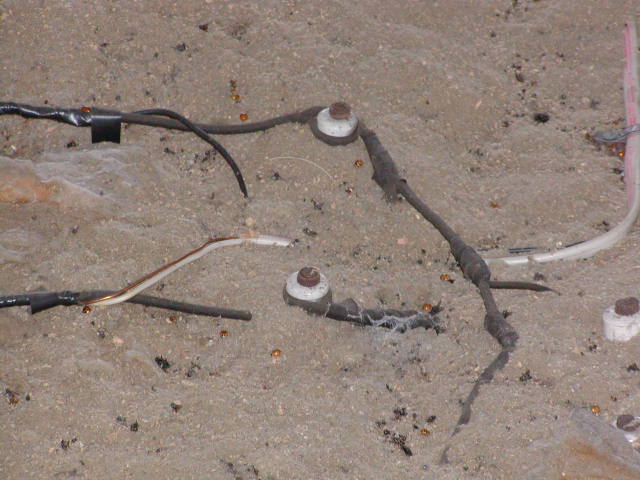
K&T wiring consists of insulated copper conductors passing through lumber framing drill-holes via protective porcelain insulating tubes. They are supported along their length by nailed-down porcelain knobs. Where wires enter a wiring device, such as a lamp or switch, or were pulled into a wall, they are protected by flexible cloth or rubber insulation called “loom.”

Advantages of Knob-and-Tube Wiring:

  • K&T wiring has a higher ampacity than wiring systems of the same gauge. The reason for this is that the hot and neutral wires are separated from one another, usually by 4 to 6 inches, which allows the wires to readily dissipate heat into free air.
  • K&T wires are less likely than Romex cables to be punctured by nails because K&T wires are held away from the framing.
  • The porcelain components have an almost unlimited lifespan.
  • The original installation of knob-and-tube wiring is often superior to that of modern Romex wiring. K&T wiring installation requires more skill to install than Romex and, for this reason, unskilled people rarely ever installed it.

Problems Associated with K&T Wiring:

  • Unsafe modifications are far more common with K&T wiring than they are with Romex and other modern wiring systems. Part of the reason for this is that K&T is so old that more opportunity has existed for improper modifications.
  • The insulation that envelopes the wiring is a fire hazard.
  • It tends to stretch and sag over time.
  • It lacks a grounding conductor. Grounding conductors reduce the chance of electrical fire and damage to sensitive equipment.
  • In older systems, wiring is insulated with varnish and fiber materials that are susceptible to deterioration.

Compared with modern wiring insulation, K&T wiring is less resistant to damage.  K&T wiring insulated with cambric and asbestos is not rated for moisture exposure. Older systems contained insulation with additives that may oxidize copper wire. Bending the wires may cause insulation to crack and peel away.

K&T wiring is often spliced with modern wiring incorrectly by amateurs. This is perhaps due to the ease by which K&T wiring is accessed.

Building Insulation:

K&T wiring is designed to dissipate heat into free air, and insulation will disturb this process. Insulation around K&T wires will cause heat to build up, and this creates a fire hazard. The 2008 National Electrical Code (NEC) requires that this wiring system not be covered by insulation. Specifically, it states that this wiring system should not be in…

hollow spaces of walls, ceilings and attics where such spaces are insulated by loose, rolled or foamed-in-place insulating material that envelops the conductors.

Local jurisdictions may or may not adopt the NEC’s requirement. The California Electrical Code, for instance, allows insulation to be in contact with knob-and-tube wiring, provided that certain conditions are met, such as, but not limited to, the following:

  • A licensed electrical contractor must certify that the system is safe.
  • The certification must be filed with the local building department.
  • Accessible areas where insulation covers the wiring must be posted with a warning sign. In some areas, this sign must be in Spanish and English.
  • The insulation must be non-combustible and non-conductive.
  • Normal requirements for insulation must be met.

Modifications:Knob and Tube Wiring on thermal insulation

When K&T wiring was first introduced, common household electrical appliances were limited to little more than toasters, tea kettles, coffee percolators and
clothes irons. The electrical requirements of mid- to late-20th century homes
could not have been foreseen during the late 18th century, a time during which electricity, to many, was seen as a passing fad. Existing K&T systems are notorious for modifications made in an attempt to match the increasing amperage loads required by televisions, refrigerators, and a plethora of other electric appliances. Many of these attempts were made by insufficiently trained handymen, rather than experienced electricians, whose work made the wiring system vulnerable to overloading.
  • Many homeowners adapted to the inadequate amperage of K&T wiring by installing fuses with resistances that were too high for the wiring. The result of this modification is that the fuses would not blow as often and the wiring would suffer heat damage due to excessive amperage loads.
  • It is not uncommon for inspectors to find connections wrapped with masking tape or Scotch tape instead of electrical tape.

K&T Wiring and Insurance:

Many insurance companies refuse to insure houses that have knob-and-tube wiring due to the risk of fire. Exceptions are sometimes made for houses where an electrical contractor has deemed the system to be safe.

Advice for those with K&T wiring:

  • Have the system evaluated by a qualified electrician. Only an expert can confirm that the system was installed and modified correctly.
  • Do not run an excessive amount of appliances in the home, as this can cause a fire.
  • Where the wiring is brittle or cracked, it should be replaced. Proper maintenance is crucial.
  • K&T wiring should not be used in kitchens, bathrooms, laundry rooms or outdoors. Wiring must be grounded in order to be used safely in these locations.
  • Rewiring a house can take weeks and cost thousands of dollars, but unsafe wiring can cause fires, complicate estate transactions, and make insurers skittish.
  • Homeowners should carefully consider their options before deciding whether to rewire their house.
  • The homeowner or an electrician should carefully remove any insulation that is found surrounding K&T wires.
  • Prospective home buyers should get an estimate of the cost of replacing K&T wiring. They can use this amount to negotiate a cheaper price for the house.

In summary, knob-and-tube wiring is likely to be a safety hazard due to improper modifications and the addition of building insulation. Inspectors need to be wary of this old system and be prepared to inform their clients about its potential dangers.


How to Determine the Age of a Building

How to Determine the Age of a Building

by Nick Gromicko and Rob London
Building technologies and fashions have followed well-known trends that allow inspectors, clients and anyone else interested to roughly determine Crude, square nails may be hundreds of years oldwhen particular buildings were constructed.  Here are some methods based on a building’s materials, components and styles.
 
Estimates of Building Age Based on Building Materials
 

Nails

  • Prior to the 1800s, nails were hand-made by blacksmiths and nail makers and appear crude compared with modern nails. They are often squared rather than rounded, and have a beaten look on the top of the head.
  • Type A- and Type B- cut nails were used from 1790 to 1830. They were made from wrought iron and are squared.
  • Wire nails, used from 1890 through today, are modern, machine-made nails that are rounded and more practical to use than the earlier designs.

Wiring

  • Aluminum wiring was used extensively from 1967 till 1975, a period during which copper was prohibitively expensive. Aluminum use was generally discontinued when its potential as a fire hazard become publicized.
  • K&T or knob-and-tube wiring was an early method of electrical wiring installed in buildings from 1880 to the 1940s. The system is considered obsolete and can be a fire hazard, although much of the fear associated with it is exaggerated.

Electrical ReceptaclesModern electrical receptacles are polarized and grounded

Electrical receptacles evolved from earliest to most recent in the following order:

  • non-polarized:  These early receptacles are made up of two slots of equal size, with no ground slot.
  • polarized:  These receptacles are two-slotted, one of which is wider than the other to allow for proper polarity.
  • grounded, polarized:  Modern receptacles were changed to permit grounding of an appliance or device. They can be identified by the round hole beneath the center of the polarized slots.

Flooring

  • In the late 19th century (1890), linoleum became common for use in hallways and passages, but it became better known for its use in kitchen floors in the 20th century, up through 1960. Originally valued for its water-resistance and affordability, it was surpassed by other floor coverings by the mid-20th century.
  • Asphalt tile was used for floor tiles starting around 1920 through the 1960s. The earliest tiles are darker because they contained more asphalt, unlike later tiles that had higher levels of synthetic binders.Old linoleum floor
  • Vinyl asbestos tiles became popular in response to consumers who wanted lighter-colored tiles of varying color patterns.

Structural Panels

  • Plywood’s use began around 1905.  It is made from thin sheets of veneer (layers of wood that are peeled from a spinning log) that are cross-laminated and glued together with a hot press. Since it is made from whole layers of logs rather than small strands, plywood has a more consistent and less rough appearance than oriented strand board (OSB).
  • Waferboard or particle board was developed in the 1970s and, like plywood, is still used today. This material appears similar to OSB, except the wooden strands from which it is composed are not aligned.
  • OSB was developed the 1980s and is manufactured from heat-cured adhesives, and then rectangularly shaped wood strands that are arranged in cross-oriented layers. Produced in large, continuous mats, OSB is a solid-panel product of consistent quality with few voids and gaps. While OSB was developed fairly receDutch-style Colonial housently, it became more popular than plywood in North America by 2000.

Keep in mind that houses, especially older ones, have evolved over many years. It can be very difficult to reliably date a building based on the presence of a single material or component. The majority of a house might be newer than its 18thcentury foundation, for instance, especially if there was a fire that destroyed the rest of the structure.

Estimates of Building Age Based on Architectural Style
  • American Colonial (1600 to 1800):  North America was colonized by Europeans who brought with them building styles from their homelands. This broad category includes the following regional styles and their characteristics:
    • New England style (1600 to 1740):  These homes feature steep roofs and narrows eaves used in simple timber-frame houses, usually located in the northeastern United States, primarily in Massachusetts, Vermont, Connecticut, New Hampshire and New York.
    • German (1600 to 1850):  Most often found in New York, Pennsylvania, Ohio and Maryland, these buildings generally feature thick, sandstone walls.
    • Spanish (1600 to 1900):  Located in the American South, Southwest, and California, these houses are simple and low, built from rocks, stucco, coquina and adobe brick, with small windows and thick walls.
    • Other home styles from the American Colonial period include Georgian, Dutch, French and Cape Cod.
  • Classical style houses (1780 to 1860):  Many houses built during the founding of the United States are a throwback to ancient Greece, emphasizing order and symmetry. Among the styles common to this era are Greek Revival, Tidewater and Antebellum.
  • Victorian (1840 to 1900): With the technological innovation of mass production came the ability to produce large homes affordably. Queen Anne, Gothic Revival, Folk and Octagon are some of the architectural styles common to this era.
  • Gilded Age (1880 to 1929): The “Gilded Age” is a term popularized by Mark Twain to describe extravagant wealth. This era saw the construction of large, Mcmansions are hastily-built and often too large for their plot of landelaborate homes owned by a class of suddenly-rich businessmen who enjoyed grandiose displays of their new wealth.
  • Early 20th Century homes:  Homes built during this period were compact and economical, somewhat smaller and less pretentious than earlier Gilded Age homes.
  • Post-War homes (1945 to 1980):  Very simple and affordable, some critics believe they have no style at all. Soldiers returning from the World War II spurred the construction of these homes, which emphasized utilitarianism over style more than preceding periods.
  • “Neo” houses (1965 to present):  Theses houses borrow styles from previous architectural eras, such as Victorian, Colonial and Mediterranean. “McMansion” is a word used to describe large, quickly-constructed, flamboyant and poorly-designed neo-eclectic homes.

Other Ways to Determine a Building’s Age:

  • Check the meter reader. Sometimes, the meter reader will bear a date stamp.
  • Check the inside of the toilet. Toilet manufacturers often stamp the inside of tanks or lids with the year the toilet was made. Toilets are usually installed right after construction, so you can often determine a newer home’s age by inspecting a toilet.
  • In log homes, it may be possible to tell the building’s age by analyzing the tree rings in a piece of timber removed from the building. The science on which this is based, dendrochronology, does not arrive at an age based on the number of tree rings, but rather focuses on patterns of tree rings and compares these with known pattern ages for a specific region. This method is destructive and it requires a specialist.
  • Local town, county, or state tax records usually indicate the date or year a building was constructed.
  • Historical real estate listings may include indications of building age.
  • Census records can prove that a house was present at the time the census was taken.
  • Papers found inside the building will often indicate when the building was present. A house will probably be at least as old as, for instance, newspapers from the 1920s found in a crawlspace.
  • Employ an architectural investigator to date the house by studying its wood, plaster, mortar and paint.
  • The aluminum spacers within thermal-paned windows often bear the year of production, which can at least provide an approximate date of installation.
  • Sewer grates are sometimes stamped with the year they were manufactured, which may provide an age for the neighborhood.
In summary, there are many ways that inspectors and their clients may estimate the age of a building.