Author Archives: bwisnewski

Closet Lighting

Clothes Closet Lighting

by Nick Gromicko and Rob London  
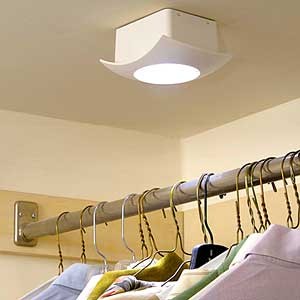
Clothes Closet Lighting Ssafe lighting for a clothes closet
People don’t often think about the fire risks posed by the light in their clothes closet, but it’s one of the few places in the house where a source of high heat can get too close to flammable materials. Lighting must be installed safely with adequate separation from clothes, boxes and other flammables stored in the closet.  Additionally, the quality of the light, as well as bulb efficiency, will influence your lighting choices.
The 2009 International Residential Code (IRC) on “Permitted Luminaires and Clearance from Clothing”
The IRC defines a “luminaire” as follows:
a complete lighting unit consisting of a lamp or lamps, together with the parts designed to distribute the light, to position and protect the lamps and ballast (where applicable), and to connect the lamps to the power supply.
Types of luminaires permitted by the 2009 IRC include:
  • surface-mounted or recessed incandescent luminaires with completely enclosed lamps, surface-mounted or recessed fluorescent luminaires; and
  • surface-mounted fluorescent or LED luminaires identified as suitable for installation within the storage area.

Luminaires not permitted by the 2009 IRC:

  • Incandescent luminaires with open or partially enclosed lamps and pendant luminaires or lamp-holders should be prohibited.

Clearances permitted by the 2009 IRC:

The minimum distance between luminaires installed in clothes closets and the nearest point of a storage area shall be as follows:

1. Surface-mounted incandescent or LED luminaires with a completely enclosed light source shall be installed on a wall above the door or on the ceiling, provided that there is a minimum clearance of 12 inches (305 mm) between the fixture and the nearest point of a storage space.

2. Surface-mounted fluorescent luminaires shall be installed on the wall above the door or on the ceiling, provided that there is a minimum clearance of 6 inches (152 mm).

3. Recessed incandescent luminaires or LED luminaires with a completely enclosed light source shall be installed in the wall or the ceiling, provided that there is a minimum clearance of 6 inches (152 mm). A hazardous lighting situation!

4. Recessed fluorescent luminaires shall be installed in the wall or on the ceiling, provided that there is a minimum clearance of 6 inches (152 mm) between the fixture and the nearest point of storage space.

5. Surface-mounted fluorescent or LED luminaires shall be permitted to be installed within the storage space where identified within this use.
 
Also, metal pull chains may be dangerous; if the base cracks, the chain can become electrified.
Color Rendering Index (CRI)
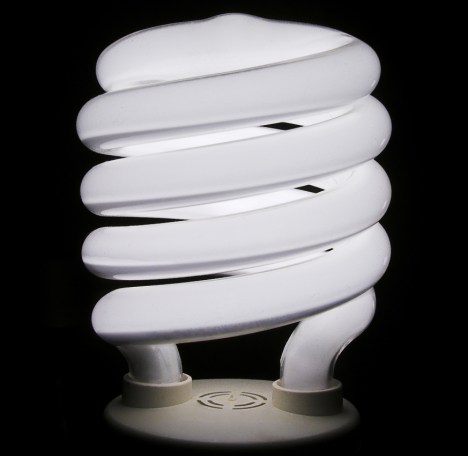
CRI is a quantitative measure of the ability of a light source to reproduce the colors of various objects faithfully, in comparison with an ideal or natural light source. The closer the CRI of a lamp is to 100, the more “true” it renders colors in the environment. Poor CRI is the reason that a shirt and pants that seemed to match at home now clash in the restroom at work. For clothes closets lighting, the CRI should be as high as possible. Incandescent lights are inefficient but they have a CRI of 100, making them the most aesthetic lighting choice. Compact fluorescents lights (CFLs) are far more efficient and have a longer life than incandescent bulbs, but they have a CRI in the low 60s, making them a poor choice for clothes closet applications. Low-voltage halogen and LED lights are relatively efficient, long-lasting, and have a high CRI, although not as high as incandescent bulbs.
In summary, homeowners should replace lighting in their clothes closets if the light has the potential to ignite flammable materials in the closet.


Lighting Quality

Lighting Quality

by Nick Gromicko and Rob London 

Efforts to enhance home energy efficiency have spurred a growth in a variety of alternative lighting sources that use less energy than conventional Compact fluorescent bulbs are often poor color renderers, despite being economicalincandescent bulbs. With this improvement comes a greater variety of light quality, although this latter property has become obscured amidst the excitement generated by energy savings. How well do these new, “green” lighting sources actually render color to the human eye? They can illuminate a room at a lower cost, but is it necessary to forfeit the ability to tell whether your clothes match just to save money and energy? Many consumers and inspectors should be aware of a metric designed to quantify this aspect, known as the color rendering index, known as CRI. CRI is a measure of how well light sources render the colors of the things they illuminate, such as skin tones and fabrics.

How is CRI measured?

The appearances of eight color samples are compared under the light in question and a reference light source on a scale of 0 to 100. The average measured differences are subtracted from 100 to arrive at the light’s CRI, which correlates positively with light quality. Thus, small average differences will result in a higher or better score, while larger differences result in a lower CRI and poorer light quality.

Criticisms of CRI

While CRI is a useful and generally accepted form of measurement, it has its criticisms.  Among them:

  • All errors made during testing are weighed equally, while human perception tends to favor or ignore certain errors over others.
  • By valuing the arithmetic mean of the errors, single large deviations become under-valued. Thus, two light sources with identical CRI values may perform differently if outlying deviations exist in a spectral band that is significant for the application.
  • More than eight samples may be required. With more samples, it would be harder for manufacturers to optimize their lamps to reproduce the test hues faithfully, which otherwise perform poorly. CRI merely measures the faithfulness of a light source to an idealized source with the same correlated color temperature, or CCT, but the ideal source itself may render colors poorly if it has an extreme color temperature due to a lack of energy at either short or long wavelengths (i.e., it may be excessively blue or red).
What is CCT, and how does it relate to CRI?
 

A common misconception is that CRI alone can be used to gauge the quality of a light source, perhaps as a result of deliberately misleading marketing campaigns. To compare lights solely based on its CRI would be akin to comparing baseball players based on batting averages while neglecting their league (i.e., your 9-year-old son may have a better batting average than Alex Rodriguez, but the two cannot be logically  compared). Similarly, CRI is a useful metric only when it is compared with light sources that have a similar CCT. This metric describes the temperature (measured in degrees Kelvin/K) that a black body radiator — an idealized material that absorbs all radiation that falls into it and emits a temperature-dependent spectrum of light — would need to be at in order to glow at a given wavelength. Higher CCTs (5,000 K or more) are considered “cool” (blueish white) colors, while lower CCTs (2,700 to 3,000 K) are “warm” (yellowish white through red) colors.

Despite their CRI rating of 100, incandescent bulbs are far from ideal for color rendering because they have a CCT of just 2,700 K. These lights are weak at the blue end of the spectrum, muddying the differences between different shades of blue. The perfect CRI rating merely means that sample hues look exactly the same as they would if illuminated by a black body radiator at the same CCT, but neither light source would render the color faithfully. Similarly, lamps that exceed 6,000 K in color temperature are too weak in the red end of the spectrum, making it difficult to distinguish reds and oranges, resulting in a washed-out appearance. An ideal light source for color rendering will have a high CRI value as well as a color temperature similar to daylight.

Warmer or lower color-temperature lights are often used in public areas to promote relaxation, while cooler or higher color-temperature lights are used to enhance concentration in offices. Thus, the best color temperature ranges are based on application, but for general indoor lighting, it is best to match the color temperature of mid-day sunlight, or approximately 5,400 K.

CRI and Color Temperatures of
Common Light Sources

Light Source
CRI
CCT (degrees K)

candle

100

1,700

incandescent bulb
100
2,700
tungsten halogen
95
3,200
Solux bulb
98
4,100
natural sunlight
100
5,000 to 6,000
Bell & Howell sunlight lamp
80 to 85
6,500
LED
70

varies

white fluorescent bulbs
50 to 98
varies

Other Factors That Affect Choice for Indoor Lighting:
  • lumens, which indicate light output;
  • lumens per watt, which indicate how much light is produced for the energy used.  This measurement shows how efficient the different types of lamps are. Standard tungsten incandescent lights generally produce around 15 lumens/watt, while some CFLs can emit more than 100 lumens/watt. Cree, Inc., recently announced that it created an LED of 208 lumens/watt, an industry-best.
  • price. CFL, LED and halogen lights vary based on initial cost. Incandescent lights are generally the cheapest option, and LEDs are sometimes prohibitively expensive.
  • disposal. Fluorescent tubes are long and fragile, making them difficult to dispose of, and all fluorescent lights contain mercury.
In summary, consumers should consider CRI and CCT before they purchase lighting.


Life Expectancy Chart

InterNACHI’s Estimated Life Expectancy Chart for Florida Homes

by Nick Gromicko, Rob London and Kenton Shepard

The following chart details the predicted life expectancy of appliances, products, materials, systems and components for homes in the state of Florida.  (It may also be applicable to states in the nearby coastal region with similar climate and weather conditions on a typical basis.)  While many components and systems in homes located in Florida and the surrounding area have service life expectancies that are comparable to those anywhere else in the U.S., those items that are regularly exposed to the elements, including saltwater, wind, sun and heat, are particularly vulnerable to premature failure compared to items installed in homes located elsewhere.  These guidelines attempt to address those differences.
Furthermore, Florida inspectors are subject to state requirements for reporting deficiencies based on expected service life:
468.8323 Home inspection report.  Upon completion of each home inspection for compensation, the home inspector shall provide a written report prepared for the client.(1) The home inspector shall report:

(a) on those systems and components inspected that, in the
professional opinion of the inspector, are significantly deficient or
are near the end of their service lives;
(b) if self-evident, a reason why the system or component reported
under paragraph (a) is significantly deficient or near the end of its
service life.

(For a comparison of service life expectancies in other areas of the U.S., see InterNACHI’s Estimated Life Expectancy Chart for Homes.)
Consumers and inspectors and other professionals advising their clients should note that these life expectancies have been determined through research and testing based on regular recommended maintenance and conditions of normal wear and tear, and not extreme weather (or other) conditions, neglect, over-use or abuse.  Therefore, they should be used as guidelines only, and not relied upon as guarantees or warranties. 
 

***********************************************************************

Surface preparation and paint quality are the most important determinants of a paint’s life expectancy. Ultraviolet (UV) rays can shorten life expectancy, especially in coastal regions that experience a lot of sunshine and heat, as well as wind-driven rain.  Additionally, conditions of high humidity indoors or outdoors can affect the lifespan of these components, which is why they should be maintained seasonally.
ADHESIVES, CAULK & PAINTS
YEARS
Caulking (interior)
5 to 8
Caulking (exterior)
1 to 3
Construction Glue
10+
Paint (exterior)
5
Paint (interior)
8 to 12
Roofing Adhesives/Cements
8+
Sealants
5
Stains
2 to 6
Appliance life expectancy depends to a great extent on the use it receives. Furthermore, consumers often replace appliances long before they become worn out due to changes in styling, technology and consumer preferences.
APPLIANCES      
YEARS
Air Conditioner (portable/window)
5 to 7
Compactors (trash)
6
Dehumidifier
8
Dishwasher
9
Disposal (food waste)
12
Dryer Vent (plastic)
5
Dryer Vent (steel)
20
Dryer (clothes)
13
Exhaust Fans
10
Freezer
10 to 20
Gas Oven
10 to 18
Hand Dryer
10 to 12
Humidifier (portable)
8
Microwave Oven
9
Range/Oven Hood
14
Electric Range
13 to 15
Gas Range
15 to 17
Refrigerator
9 to 13
Swamp Cooler
5 to 15
Washing Machine
5 to 15
Whole-House Vacuum System
20
Modern kitchens are larger and more elaborate, and together with the family room, modern kitchens now form the “great room.”
CABINETRY & STORAGE   
YEARS
Bathroom Cabinets
50+
Closet Shelves 100+
Entertainment Center/Home Office 10
Garage/Laundry Cabinets 70+
Kitchen Cabinets 50
Medicine Cabinet 25+
Modular (stock manufacturing-type)
50
Walls and ceilings last the full lifespan of the home.
CEILINGS & WALLS
YEARS
Acoustical Tile Ceiling
40+ (older than 25 years may contain asbestos)
Ceramic Tile
70+
Concrete
75+
Gypsum
75
Wood Paneling
20 to 50
Suspended Ceiling
25+
Natural stone countertops, which are less expensive than they were just a few years ago, are becoming more popular, and one can expect them to last a lifetime. Cultured marble countertops have a shorter life expectancy, however.
COUNTERTOPS
YEARS
Concrete
50
Cultured Marble
20
Natural Stone
100+
Laminate
20 to 30
Resin
10+
Tile
100+
Wood
100+
Decks are exposed to a wide range of conditions in different climates, from wind and hail in some areas, to relatively consistent, dry weather in others. See FASTENERS & STEEL section for fasteners.
DECKS
YEARS 
Deck Planks
10
Composite
8 to 15
Structural Wood
5 to 20
Exterior fiberglass, steel and wood doors will last as long as the house, while vinyl and screen doors have a shorter life expectancy. The gaskets/weatherstripping of exterior doors may have to be replaced every 5 to 8 years.
DOORS
YEARS
Closet (interior)
100+
Fiberglass (exterior)
100+
Fire-Rated Steel (exterior)
100+
French (interior)
30 to 50
Screen (exterior) 10
Sliding Glass/Patio (exterior)
10 (for roller wheel/track repair/replacement)
Vinyl (exterior) 10
Wood (exterior)
30+
Wood (hollow-core interior)
20 to 30
Wood (solid-core interior)
30 to 100+
Copper-plated wiring, copper-clad aluminum, and bare copper wiring are expected to last a lifetime, whereas electrical accessories and lighting controls, such as dimmer switches, may need to be replaced after 10 years.  GFCIs could last 30 years, but much less if tripped regularly.  Remember that faulty, damaged or overloaded electrical circuits or equipment are the leading cause of house fires, so they should be inspected regularly and repaired or updated as needed.
ELECTRICAL
YEARS
Accessories
10+
Arc-Fault Circuit Interrupters (AFCIs)
30
Bare Copper
100+
Bulbs (compact fluorescent)
8,000 to 10,000+ hours
Bulbs (halogen)
4,000 to 8,000+ hours
Bulbs (incandescent)
1,000 to 2,000+ hours
Bulbs (LED)
30,000 to 50,000+ hours
Copper-Clad Aluminum
100+
Copper-Plated
100+
Fixtures
40
Ground-Fault Circuit Interrupters (GFCIs)
up to 30
Lighting Controls
30+
Residential Propane Backup Generator
12
Service Panel
60
Solar Panels
20 to 30
Solar System Batteries
3 to 12
Wind Turbine Generator
20
Floor and roof trusses and laminated strand lumber are durable household components, and engineered trim may last 30 years.
ENGINEERED LUMBER
YEARS
Engineered Joists
80+
Laminated Strand Lumber
100+
Laminated Veneer Lumber
80+
Trusses
100+
Fastener manufacturers do not give lifespans for their products because they vary too much based on where the fasteners are installed in a home, the materials in which they’re installed, and the local climate and environment.  However, inspectors can use the guidelines below for humid and coastal environments to make educated judgments about the materials they inspect.
FASTENERS, CONNECTORS & STEEL
YEARS
Adjustable Steel Columns
50+
Fasteners (bright)
25 to 40
Fasteners (copper)
50 to 65
Fasteners (electro-galvanized)
10 to 30
Fasteners (hot-dipped galvanized)
15 to 60
Fasteners (stainless)
100
Steel Beams
50 to 100+
Steel Columns 100+
Steel Plates 35 to 75
Flooring life is dependent on maintenance and the amount of foot traffic the floor endures.
FLOORING
YEARS
All Wood Floors
100+
Bamboo
100+
Brick Pavers
100+
Carpet
8 to 10
Concrete
50+
Engineered Wood
50+
Exotic Wood
100+
Granite
100+
Laminate
15 to 25
Linoleum
25
Marble
100+
Other Domestic Wood
100+
Slate
100
Terrazzo
75+
Tile
75 to 100
Vinyl
25
Concrete and poured-block footings and foundations will last a lifetime, assuming they were properly built.  Waterproofing with bituminous coating lasts 10 years, but if it cracks, it is immediately damaged.
FOUNDATIONS
YEARS
Baseboard Waterproofing System
30
Bituminous-Coating Waterproofing
6
Concrete Block
75+
Insulated Concrete Forms (ICFs)
80
Post and Pier
15 to 45
Post and Tensioned Slab on Grade
80+
Poured-Concrete Footings and Foundation
80+
Slab on Grade (concrete)
75
Wood Foundation
5 to 20
Permanent Wood Foundation (PWF; treated)
50 to 75
Framing and structural systems have extended longevities; poured-concrete systems, timber frame houses and structural insulated panels will all last a lifetime.
FRAMING
YEARS
Log
75+
Poured-Concrete Systems
80+
Steel
75+
Structural Insulated Panels (SIPs)
75+
Timber Frame
80+
The quality and frequency of use will affect the longevity of garage doors and openers.
GARAGES
YEARS
Garage Doors
10 to 30
Garage Door Openers
10 to 15
Home technology systems have diverse life expectancies and may have to be upgraded due to evolution in technology.
HOME TECHNOLOGY
YEARS
Built-In Audio
20
Carbon Monoxide Detectors* 5
Door Bells
35
Home Automation System
5 to 50
Intercoms
20
Security System
5 to 20
Smoke/Heat Detectors*
less than 10
Wireless Home Networks
5 to ?
* Batteries should be changed at least annually.
Thermostats may last 35 years but they are usually replaced before they fail due to technological improvements.
HVAC
YEARS
Air Conditioner (central)
5 to 12
Air Exchanger
15
Attic Fan
15 to 25
Boiler
40 (if installed)
Burner
10+
Ceiling Fan
5 to 10
Condenser
5 to 7 (for coastal areas, or 15 to 20 inland)
Dampers
20+
Dehumidifier
8
Diffusers, Grilles and Registers
25
Ducting
60 to 100
Electric Radiant Heater
40
Evaporator Cooler
15 to 25
Furnace
15 to 25 (if installed)
Gas Fireplace
15 to 25
Handler Coil
1 to 3
Heat Exchanger
10 to 15
Heat Pump
10 to 15
Heat-Recovery Ventilator
20
Hot-Water and Steam-Radiant Boilers
40
Humidifiers
12
Induction and Fan-Coil Units
10 to 15
Chimney Cap (concrete)
50+
Chimney Cap (metal)
8 to 10
Chimney Cap (mortar)
10+
Chimney Flue Tile
20+
Thermostats
35
Ventilator 7
As long as they are not punctured, cut or burned and are kept dry and away from UV rays, cellulose, fiberglass and foam insulation materials will last a lifetime. This is true regardless of whether they were installed as loose-fill, housewrap or batts/rolls.
INSULATION & INFILTRATION BARRIERS
YEARS
Batts/Rolls
100+
Black Paper (felt paper)
15 to 30
Cellulose
100+
Fiberglass
100+
Foamboard
100+
Housewrap
80+
Liquid-Applied Membrane
50
Loose-Fill
100+
Rock Wool
100+
Wrap Tape
80+
Masonry is one of the most enduring household components. Fireplaces, chimneys and brick veneers can last the lifetime of a home.
MASONRY & CONCRETE   
YEARS
Brick
75+
Insulated Concrete Forms (hybrid block)
75+
Concrete Masonry Units (CMUs)
75+
Man-Made Stone 15
Masonry Sealant
2 to 10
Stone
75+
Stucco/EIFS
25+
Veneer
75+
Custom millwork and stair parts will last a lifetime and are typically only upgraded for aesthetic reasons.
MOLDING, MILLWORK & TRIM
YEARS
Attic Stairs (pull-down)
50
Custom Millwork
100+
Pre-Built Stairs (interior)
100+
Stair Parts (interior)
100+
Stairs (interior)
100+
The lifetime of any interior wood product depends heavily on moisture intrusion.
PANELS
YEARS
Flooring Underlayment
25
Hardboard
40
Particleboard
60
Plywood
100
Softwood
30
Oriented Strand Board (OSB)
60
Wall Panels
100+
The quality of plumbing fixtures varies dramatically.  The mineral content of water can shorten the life expectancy of water heaters and clog showerheads.  Also, some finishes may require special maintenance with approved cleaning agents per the manufacturers in order to last their expected service lives.
PLUMBING, FIXTURES & FAUCETS
YEARS
ABS and PVC Waste Pipe
50 to 80
Accessible/ADA Handles
100+
Acrylic Kitchen Sink
50
Cast-Iron Bathtub
100
Cast-Iron Waste Pipe (above ground)
40
Cast-Iron Waste Pipe (below ground)
50 to 60
Concrete Waste Pipe
100+
Copper Water Lines
70
Enameled Steel Kitchen Sink
5 to 10
Faucets and Spray Hose
15 to 20
Fiberglass Bathtub and Shower
20
Gas Lines (black steel)
75
Gas Lines (flex)
30
Hose Bib
20 to 30
Instant (on-demand) Water Heater
10
PEX 40
Plastic Water Lines
75
Saunas/Steam Room
15 to 20
Sewer Grinder Pump
10
Shower Enclosure/Module
50
Shower Doors
20
Showerheads
100+ (if not clogged by mineral/other deposits)
Soapstone Kitchen Sink
100+
Sump Pump
7
Toilet Tank Components
5
Toilets, Bidets and Urinals
100+ (if not cracked)
Vent Fan (ceiling)
5 to 10
Vessel Sink (stone, glass, porcelain, copper)
5 to 20+
Water Heater (conventional)
6 to 12
Water Line (copper)
50
Water Line (plastic)
50
Well Pump
15
Water Softener
20
Whirlpool Tub
20 to 50
Radon systems have but one moving part:  the radon fan.

RADON SYSTEMS
YEARS
Air Exchanger
15
Barometric Backdraft Damper/Fresh-Air Intake
20
Caulking
5 to 10
Labeling
25
Manometer
15
Piping
50+
Radon Fan
5 to 8
The life of a roof depends on local weather conditions, building and design, material quality, and adequate maintenance.  Hot climates drastically reduce asphalt shingle life.  Roofs in areas that experience severe weather, such as hail, tornadoes and/or hurricanes may also experience a shorter-than-normal lifespan overall or may incur isolated damage that requires repair in order to ensure the service life of the surrounding roofing materials.
ROOFING
YEARS
Aluminum Coating
2 to 6
Asbestos Shakes
30 to 50+
Asphalt Shingles (3-tab)
10 to 12
Asphalt (architectural) 15 to 20
BUR (built-up roofing)
5 to 15
Cellulose Fiber
10
Clay/Concrete
80+
Coal and Tar
18
Copper
50+
EPDM (ethylene propylene diene monomer) Rubber
10 to 15
Fiber Cement
18
Green (vegetation-covered)
5 to 20
Metal
17 to 20
Modified Bitumen
10
Simulated Slate
10 to 25
Slate
50+
TPO 10 to 12
Wood
10
Outside siding materials typically last a lifetime.  Some exterior components may require protection through appropriate paints or sealants, as well as regular maintenance.  Also, while well-maintained and undamaged flashing can last a long time, it is their connections that tend to fail, so seasonal inspection and maintenance are strongly recommended.
SIDINGS, FLASHING & ACCESSORIES
YEARS
Aluminum Siding
20 to 35
Aluminum Gutters, Downspouts, Soffit and Fascia
15 to 35+
Asbestos Shingle
20
Brick
80+
Cementitious
80+
Copper Downspouts
80
Copper Gutters
40+
Engineered Wood
80+
Fiber Cement
75+
Galvanized Steel Gutters/Downspouts
15
Manufactured Stone
80+
Stone
80+
Stucco/EIFS
25+
Trim 18
Vinyl Siding 50
Vinyl Gutters and Downspouts
20+
Wood/Exterior Shutters 15
Site and landscaping elements have life expectancies that vary dramatically.
SITE & LANDSCAPING
YEARS
American Red Clay
75+
Asphalt Driveway
10 to 15
Brick and Concrete Patio
8 to18
Clay Paving
75+
Concrete Walks
30+
Controllers
12
Gravel Walks
4 to 6
Mulch
1 to 2
Polyvinyl Fencing 75+
Sprinkler Heads 8 to 12
Underground PVC Piping 50+
Valves
12 to 15
Wood Chips
1 to 5
Wood Fencing
10
Swimming pools are comprised of many systems and components, all with varying life expectancies, depending on their exposure to climatic and weather conditions.  Also, proper maintenance is key, especially concerning the pool water’s chemical balance.
SWIMMING POOLS
YEARS
Chlorine Generator (salt water)
5
Cover
3 to 5
Deck Finish (acrylic)
5
Diving Board
8 to 10
Gas Heater
3 to 5
Filter (sand)
5 to 10 (sand must be replaced every 3 years)
Filter (cartridge)
2
Filter Grid (DE)
5
Heat Pump
5 to 8
Interior Finish
10 to 20
Motor*
5 to 8
Vinyl Liner
8 to 10
Pool Lights (fiber optic)
3 to 5
Pool Lights (incandescent)
3
Pool Lights (LED)
5 to 7
Pool Water Heater
5
PVC Ball Valve
up to 2
Shell (concrete)
20+
Shell (fiberglass)
20+
Solar Heater
10 to 20
Waterline Tile
10+
 * Replacement motors tend to last half the lifespan of their original counterparts.
Aluminum windows are expected to last between 15 and 20 years, while wooden windows should last nearly 30 years.
WINDOWS
YEARS
Aluminum/Aluminum-Clad
10 to 15
Double-Pane
5 to 15
Skylights
5 to 15
Window Glazing 8+
Vinyl Windows
10 to 30
Wood
15+

Note: Life expectancy varies with usage, weather, installation, maintenance and quality of materials.  This list should be used only as a general guideline and not as a guarantee or warranty regarding the performance or life expectancy of any appliance, product, system or component.


Kickout Flashing

Kickout Flashing

by Nick Gromicko, Rob London and Kenton Shepard 
Kickout flashing, also known as diverter flashing, is a special type of flashing that diverts rainwater away from the cladding and into the gutter. When installed properly, they provide excellent protection against the penetration of water into the building envelope. 
Several factors can lead to rainwater intrusion, but a missing kickout flashing, in particular, often results in concentrated areas of water accumulation and potentially severe damage to exterior walls. InterNACHI inspectors should make sure that kickouts are present where they are needed and that they are installed correctly. Water penetration into the cladding can occasionally be observed on the exterior wall in the form of vertical water stains, although inspectors should not rely on visual identification. There may be severe damage with little or no visible evidence.
Inspectors may observe the following problems associated with kickout flashing:
The kickout was never installed.
  • The need for kickout flashing developed fairly recently and the builder may not have been aware that one was required. The increased amount of insulation and building wrap that is used in modern construction makes buildings less breathable and more likely to sustain water damage. Kickout flashing prevents rainwater from being absorbed into the wall and is more essential than ever.
The following are locations where kickout flashing is critical:
  • anywhere a roof and exterior wall intersect, where the wall continues past the lower roof-edge and gutter. If a kickout flashing is absent in this location, large amounts of water may miss the gutter, penetrate the siding, and become trapped inside the wall; and
  • where gutters terminate at the side of a chimney.


The kickout was improperly installed.

  • The bottom seam of the flashing must be watertight. If it is not, water will leak through the seam and may penetrate the cladding.
  • The angle of the diverter should never be less than 110 degrees.

The kick-out was modified by the homeowner.

  • Homeowners who do not understand the importance of kickouts may choose to alter them because they are unsightly. A common way this is done is to shorten their height to less than the standard six inches (although some manufacturers permit four inches), which will greatly reduce their effectiveness. Kickout flashings should be the same height as the side wall flashings.
  • Homeowners may also make kickout flashings less conspicuous by cutting them flush with the wall.
In summary, kickout flashing should be present and properly installed in order to direct rainwater away from the cladding.


Insulation R-Value

Insulation R-Value

by Nick Gromicko and Ethan Ward

As energy efficiency has become an increasing concern among builders and homeowners, the attributes and performance of building materials and components are being scrutinized more closely.  In order to maximize levels of efficiency by examining the details of how each individual component of a house performs on its own and as part of a dynamic system, very specific properties are measured and taken into account.  This can be especially helpful when trying to select the best building materials for a given application.  R-value is the measurement used when quantifying a specific material’s level of thermal resistance, which is the inverse of U-value, which measures thermal conductance.  R-value is often the standard consideration when discussing the effectiveness of insulation.  Inspectors may want to be familiar with the specifics of R-value ratings, especially when inspecting insulation and if they also perform energy audits.

How Does R-Value Relate to Insulation?

Heating and cooling costs account for 50% to 70% of energy used in an average U.S. home. Inadequate insulation can account for a lot of wasted energy, so it is important to be sure that insulation installed is doing its job properly.  The function of insulation is to provide resistance to the flow of heat, and R-value is the measure of exactly this attribute for a given material.  A higher R-value equates to higher resistance to heat flow and greater effectiveness in insulating.  An insulation material’s R-value, in conjunction with how and where it is installed, will determine its overall thermal resistance and effectiveness.  Adding the R-values of each layer of material contained in one building component, such as a wall or ceiling with multiple layers of insulation, will help determine the thermal resistance of the whole component.  The way the insulation is installed, as well as other factors, will also affect its thermal resistance.

Important Factors to Consider When Measuring Thermal Resistance

When considering R-value as a means to determine the thermal resistance of a building component, there are other factors that must also be taken into account.  While R-values are an excellent guide for comparing the attributes of different insulation products, they apply only when the insulation is properly installed.  For example, if two layers of insulation are smashed into the thickness intended for one layer, the R-value does not double.  Likewise, if a single layer of insulation is compressed during installation, it will not be as effective.  Stuffing batt insulation sized for 5 inches into a 4-inch wall cavity will actually lower its R-value.  Ensuring that insulation is correctly installed will help allow the product’s full benefits to be realized.

Also important to consider is the fact that even when installed correctly, insulation affects heat transfer through the insulation itself but not through other materials, such as glass windows and studs.  If there are structural gaps in any building penetrations, even insulation with a high R-value that’s installed properly cannot mitigate heat loss from air leaks.  Studs and windows provide a parallel heat conduction path, and insulation between studs in a wall does not restrict heat flow through the studs.  This heat flow is called thermal bridging, and the overall R-value of the wall will be different from the R-value of the insulation itself.

Calculating and Converting R-Value

The equation used to calculate R-value may be of interest to some inspectors because if the R-value is known, the equation can also be used to help calculate heat loss.  The equation for determining R-value is as follows:

R-value = temperature difference x area x time ÷ heat loss

The temperature difference is expressed in degrees Fahrenheit, the area in square feet, the time in hours, and heat loss in BTUs.  Since European R-value uses different units of measure (Celsius, Kelvin, meters, etc.), it may be helpful to know how to convert a European R-value into a U.S. R-value.  This is done by multiplying the European value by 0.176 and dividing 1 by the result.

The FTC and DOE on R-Value

In the 1970s, the Federal Trade Commission (FTC) created a rule requiring insulation manufacturers to disclose R-values at the point of sale and in some ads.  This is intended to protect purchasers from false claims made by manufacturers and to create a standard of comparison for products.

The U.S. Department of Energy (DOE) has issued recommendations for insulation R-values in new and existing homes.  The recommendations are based on a comparison of the cost for installing insulation versus potential future energy savings.  Their recommendations for attics, cathedral ceilings, walls and floors are generally greater than what is actually required by most current building codes.

R-value ratings are a useful tool, especially when comparing the effectiveness of insulation products, but understanding a bit about how other factors affect a building component’s thermal resistance is important if insulation is to be used to its full benefit.