Inspector's Corner

Carbon Monoxide Poisoning and Detectors

Carbon Monoxide Poisoning and Detectors

by Nick Gromicko and Rob London 
Carbon monoxide (CO) is a colorless, odorless, poisonous gas that forms from incomplete combustion of fuels, such as natural or liquefied petroleum gas, oil, wood or coal.

Facts and Figures

  • 480 U.S. residents died between 2001 and 2003 from non-fire-related carbon-monoxide poisoning.
  • Most CO exposures occur during the winter months, especially in December (including 56 deaths, and 2,157 non-fatal exposures), and in January (including 69 deaths and 2,511 non-fatal exposures). The peak time of day for CO exposure is between 6 and 10 p.m.
  • Many experts believe that CO poisoning statistics understate the problem. Because the symptoms of CO poisoning mimic a range of common health ailments, it is likely that a large number of mild to mid-level exposures are never identified, diagnosed, or accounted for in any way in carbon monoxide statistics.
  • Out of all reported non-fire carbon-monoxide incidents, 89% or almost nine out of 10 of them take place in a home.

Physiology of Carbon Monoxide Poisoning

When CO is inhaled, it displaces the oxygen that would ordinarily bind with hemoglobin, a process the effectively suffocates the body. CO can poison slowly over a period of several hours, even in low concentrations. Sensitive organs, such as the brain, heart and lungs, suffer the most from a lack of oxygen.

High concentrations of carbon monoxide can kill in less than five minutes. At low concentrations, it will require a longer period of time to affect the body. Exceeding the EPA concentration of 9 parts per million (ppm) for more than eight hours may have adverse health affects. The limit of CO exposure for healthy workers, as prescribed by the U.S. Occupational Health and Safety Administration, is 50 ppm.
Potential Sources of Carbon Monoxide

Any fuel-burning appliances which are malfunctioning or improperly installed can be a source of CO, such as:
  • furnaces;
  • stoves and ovens;
  • water heaters;
  • dryers;
  • room and space heaters;
  • fireplaces and wood stoves;
  • charcoal grills;
  • automobiles;
  • clogged chimneys or flues;
  • space heaters;
  • power tools that run on fuel;
  • gas and charcoal grills;
  • certain types of swimming pool heaters; and
  • boat engines.

PPM

% CO
in air

Health Effects in Healthy Adults

Source/Comments

0

0%

no effects; this is the normal level in a properly operating heating appliance  

35

.0035%

maximum allowable workplace exposure limit for an eight-hour work shift

The National Institute for Occupational Safety and Health (NIOSH)

50

.005%

maximum allowable workplace exposure limit for an eight-hour work shift               OSHA

100

.01%

slight headache, fatigue, shortness of breath,
errors in judgment
 

125

.0125%


workplace alarm must sound (OSHA)

200

.02%

headache, fatigue,
nausea, dizziness
 

400

.04%

severe headache, fatigue, nausea, dizziness, confusion; can be life-threatening after three hours of exposure

evacuate area immediately

800

.08%

convulsions, loss of consciousness;
death within three hours.

evacuate area immediately

12,000

1.2%

nearly instant death  
CO Detector Placement

CO detectors can monitor exposure levels, but do not place them:

  • directly above or beside fuel-burning appliances, as appliances may emit a small amount of carbon monoxide upon start-up;
  • within 15 feet of heating and cooking appliances, or in or near very humid areas, such as bathrooms;
  • within 5 feet of kitchen stoves and ovens, or near areas locations where household chemicals and bleach are stored (store such chemicals away from bathrooms and kitchens, whenever possible);
  • in garages, kitchens, furnace rooms, or in any extremely dusty, dirty, humid, or greasy areas;
  • in direct sunlight, or in areas subjected to temperature extremes. These include unconditioned crawlspaces, unfinished attics, un-insulated or poorly insulated ceilings, and porches;
  • in turbulent air near ceiling fans, heat vents, air conditioners, fresh-air returns, or open windows. Blowing air may prevent carbon monoxide from reaching the CO sensors.

Do place CO detectors:

  • within 10 feet of each bedroom door and near all sleeping areas, where it can wake sleepers. The Consumer Product Safety Commission (CPSC) and Underwriters Laboratories (UL) recommend that every home have at least one carbon monoxide detector for each floor of the home, and within hearing range of each sleeping area;
  • on every floor of your home, including the basement (source:  International Association of Fire Chiefs/IAFC);
  • near or over any attached garage. Carbon monoxide detectors are affected by excessive humidity and by close proximity to gas stoves (source:  City of New York);
  • near, but not directly above, combustion appliances, such as furnaces, water heaters, and fireplaces, and in the garage (source:  UL); and
  • on the ceiling in the same room as permanently installed fuel-burning appliances, and centrally located on every habitable level, and in every HVAC zone of the building (source:  National Fire Protection Association 720). This rule applies to commercial buildings.

In North America, some national, state and local municipalities require installation of CO detectors in new and existing homes, as well as commercial businesses, among them:  Illinois, Massachusetts, Minnesota, New Jersey, Vermont and New York City, and the Canadian province of Ontario. Installers are encouraged to check with their local municipality to determine what specific requirements have been enacted in their jurisdiction.

How can I prevent CO poisoning?

  • Purchase and install carbon monoxide detectors with labels showing that they meet the requirements of the new UL standard 2034 or Comprehensive Safety Analysis 6.19 safety standards.
  • Make sure appliances are installed and operated according to the manufacturer’s instructions and local building codes. Have the heating system professionally inspected by an InterNACHI inspector and serviced annually to ensure proper operation. The inspector should also check chimneys and flues for blockages, corrosion, partial and complete disconnections, and loose connections.
  • Never service fuel-burning appliances without the proper knowledge, skill and tools. Always refer to the owner’s manual when performing minor adjustments and when servicing fuel-burning equipment.
  • Never operate a portable generator or any other gasoline engine-powered tool either in or near an enclosed space, such as a garage, house or other building. Even with open doors and windows, these spaces can trap CO and allow it to quickly build to lethal levels.
  • Never use portable fuel-burning camping equipment inside a home, garage, vehicle or tent unless it is specifically designed for use in an enclosed space and provides instructions for safe use in an enclosed area.
  • Never burn charcoal inside a home, garage, vehicle or tent.
  • Never leave a car running in an attached garage, even with the garage door open.
  • Never use gas appliances, such as ranges, ovens or clothes dryers to heat your home.
  • Never operate un-vented fuel-burning appliances in any room where people are sleeping.
  • During home renovations, ensure that appliance vents and chimneys are not blocked by tarps or debris. Make sure appliances are in proper working order when renovations are complete.
  • Do not place generators in the garage or close to the home. People lose power in their homes and get so excited about using their gas-powered generator that they don’t pay attention to where it is placed. The owner’s manual should explain how far the generator should be from the home.
  • Clean the chimney. Open the hatch at the bottom of the chimney to remove the ashes.  Hire a chimney sweep annually.
  • Check vents. Regularly inspect your home’s external vents to ensure they are not obscured by debris, dirt or snow.
In summary, carbon monoxide is a dangerous poison that can be created by various household appliances. CO detectors must be placed strategically throughout the home or business in order to alert occupants of high levels of the gas.
 

Tobacco Odor Removal

Tobacco Odor Removal

by Nick Gromicko and Rob London

Tobacco smoke creates an odor that is notorious for its ability to saturate living spaces and persist long after its source is gone. Inspectors may be asked by clients who recently purchased a smoke-infused home, or by sellers before their house goes on the market, about how to remedy the situation.Tobacco smoke odor can be difficult to remove

Facts About Tobacco Smoke and its Residue

  • Smoke particles can be as small as .001% of the width of a human hair, which allows them to penetrate almost any part of a house. Tobacco smoke can easily circulate through a building’s ventilation system or come up through apartment floors. Tenant/tenant and tenant/landlord disputes commonly arise when smoke odors penetrate adjacent housing units.
  • It is not clear whether tobacco smoke odor is dangerous or if it is merely a nuisance. While tobacco smoke is a known carcinogen, little is known about the health effects of the particles that are left in the air after you can no longer see the smoke. The American Cancer Society states of cigarette odors, “Though unknown, the cancer-causing effects would likely be very small compared with direct secondhand smoke exposure, such as living in a household that has a smoker.”

Odor-Absorbing Materials

The following materials are believed to be capable of absorbing or neutralizing tobacco smoke odors, at least temporarily:

  • vinegar. Place a bowl of vinegar in each affected room overnight.
  • citrus. Leave a large amount of citrus peels in your home for several days or until they have become desiccated.
  • baking soda. Sprinkle baking soda over the smoke-affected area and let it sit for a few hours before vacuuming it up. Be sure to test the baking soda on a small part of the surface to ensure that the surface or fabric doesn’t react unfavorably to the baking soda.
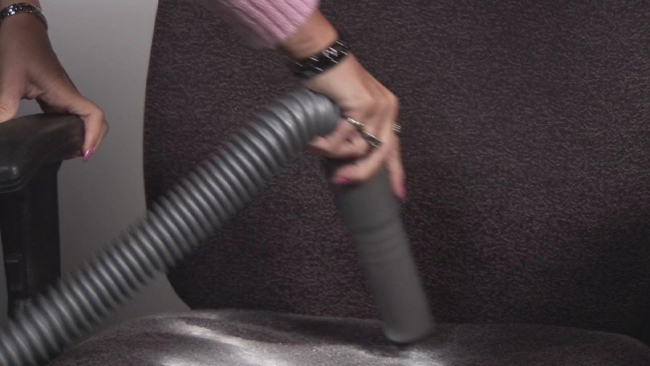
  • coffee grounds. Pour coffee grounds into several coffee filters and tie them closed,To deodorize furniture, baking soda can be temporarily applied to furniture and then removed with a vacuum leaving them in affected areas.
  • charcoal. As you would with vinegar, place charcoal into bowls and leave them in smoke-infused rooms overnight.

Removal Strategies for Smoke Odor

  • Open all windows and turn on fans. Ventilation is probably the best way to remove any odor.
  • Clean light bulbs. Just as some scent-diffusers rely on heat from light bulbs to disperse the aroma of the scented oil, it’s possible that the oily residue from nicotine and other cigarette byproducts is dispersed throughout the living area the same way.  Anecdotal reports suggest that light bulbs attract smoke residue.  It has also been claimed that bulbs will release smoke odors when they are turned on.  Perhaps replacing incandescent bulbs with higher-efficiency bulbs that do not get as hot would help alleviate this problem.
  • Thoroughly clean all hard surfaces, preferably with cleaners that contain ammonia, although woodwork requires cleaners that are not as acidic.
  • Surfaces may be painted to trap odor, although it may be possible for odors to gradually seep through paint barriers.
  • Remove carpeting, as it is nearly impossible to remove smoke particles from carpet. Thoroughly scrub the flooring beneath before installing new carpet. If the carpet cannot be replaced, have it professionally cleaned.
  • Soak blinds in a bathtub full of all-purpose cleaner, scrub them thoroughly, and hang them to dry.
  • Send curtains out to be professionally cleaned or replace them.
  • Purchase a chemical sponge to remove smoke residue from lampshades, books and other materials.
  • Use an ozone generator. Ozone, as it has three oxygen atoms, is highly unstable and will oxidize easily. When it is introduced into an area, ozone attaches itself to the odor molecules and oxidizes them into their basic elements–carbon dioxide and hydrogen, which have no odor. Beware that ozone is dangerous and ozone generators should only be used in unoccupied spaces. Be sure to read our article on the subject before purchasing an ozone generator.
  • Use a HEPA filter.
  • Burn “smoker candles.” Candles that contain enzymes to help neutralize and remove smoke odors are widely available. They may also be used to remove cooking and pet odors.
  • Replace all heating and air filters regularly, as they tend to harbor cigarette odors and other irritants.
In summary, there are a variety of ways to remove cigarette smoke odors from buildings.

Backflow Prevention

Backflow Prevention

by Nick Gromicko, Rob London and Kenton Shepard
Backflow is the reversal of the normal and intended direction of water flow in a water system. Devices and assemblies known as backflow preventers are installed to prevent backflow, which can contaminate potable water supplies.
 
Why is backflow a problem?

Backflow is a potential problem in a water system because it can spread contaminated water back through a distribution system. For example, backflow at uncontrolled cross connections (cross-connections are any actual or potential connection between the public water supply and a source of contamination or pollution) can allow pollutants or contaminants to enter the potable water system. Sickness can result from ingesting water that has been contaminated due to backflow.

Backflow may occur under the following two conditions:

back-pressure:
Back-pressure is the reverse from normal flow direction within a piping system as the result of the downstream pressure being higher than the supply pressure. This reduction in supply pressure occurs whenever the amount of water being used exceeds the amount of water being supplied (such as during water-line flushing, fire-fighting, or breaks in water mains).

back-siphonage:

Back-siphonage is the reverse from normal flow direction within a piping system that is caused by negative pressure in the supply piping (i.e., the reversal of normal flow in a system caused by a vacuum or partial vacuum within the water supply piping). Back-siphonage can occur when there is a high velocity in a pipe line, when there is a line repair or break that is lower than a service point, or when there is lowered main pressure due to high-water withdrawal rate (such as during fire-fighting or water-main flushing).
Atmospheric Vacuum Breakers

Backflow prevention for residences is most commonly accomplished through the use of atmospheric vacuum breakers (AVBs). AVBs operate by allowing the entry of air into a pipe so that a siphon cannot form. AVBs are bent at 90 degrees and are usually composed of brass. Compared with backflow preventer assembles, AVBs are small, simple and inexpensive devices that require little maintenance or testing. They have long life spans and are suitable for residential purposes such as sprinkler systems. InterNACHI inspectors can check for the following:

  • The AVB must be at least 6 inches above any higher point downstream of the device. For this reason, they can never be installed below grade. Even if they are installed 6 inches above grade, inspectors should make sure that they are not installed less than 6 inches above some other point in the system downstream of the device.
  • The AVB cannot be installed in an enclosure containing air contaminants. If contaminated air enters the water piping, it can poison the potable water supply.
  • A shut-off valve should never be placed downstream of any AVB, as this would result in continuous pressure on the AVB.
  • AVBs cannot be subject to continuous pressure for 12 hours in any 24-hour period or they may malfunction.
  • Spillage of water from the top of the AVB is an indication that the device has failed and needs to be replaced.


Types of Backflow Preventer Assemblies

Some types of assemblies are common in commercial and agricultural applications but are rare for residential uses. The appropriate type of backflow preventer for any given application will depend on the degree of potential hazard. The primary types of backflow preventers appropriate for use at municipalities and utilities are:

  • double check valves:  These are commonly used in elevated tanks and non-toxic boilers. Double check-valve assemblies are effective against backflow caused by back-pressure and back-siphonage and are used to protect the potable water system from low-hazard substances. Double-checks consist of two positive-seating check valves installed as a unit between two tightly closing shut-off valves, and are fitted with testcocks.
  • reduced pressure principle assemblies:  These are commonly used in industrial plants, hospitals, morgues, chemical plants, irrigation systems, boilers, and fire sprinkler systems. Reduced pressure principle assemblies (RPs) protect against back-pressure and back-siphonage of pollutants and contaminants. The assembly is comprised of two internally loaded, independently operating check valves with a mechanically independent, hydraulically dependent relief valve between them.
  • pressure vacuum breakers:  These are commonly used in industrial plants, cooling towers, laboratories, laundries, swimming pools, lawn sprinkler systems, and fire sprinkler systems. Pressure vacuum breakers use a check valve designed to close with the aid of a spring when water flow stops. Its air-inlet valve opens when the internal pressure is one psi above atmospheric pressure, preventing non-potable water from being siphoned back into the potable system. The assembly includes resilient, seated shut-off valves and testcocks.
Requirements for Testers and Inspectors

A number of organizations, such as the American Water Works Association (AWWA) and the American Backflow Prevention Association (ABPA) offer certification courses designed to train professionals to test backflow preventers. Requirements for training vary by jurisdiction. Inspection of backflow preventers requires knowledge of installation requirements, although inspectors are not required to become certified.
In summary, backflow preventers are designed to prevent the reverse flow of water in a potable water system. They come in a number of different types, each of which is suited for different purposes.

Ladder Safety

Ladder Safety

by Nick Gromicko, Rob London and Kenton Shepard
A ladder is a structure designed for climbing that consists of two long side-pieces joined at uniform intervals by rungs or steps. Extension ladder
According to the American Ladder Institute, there are nine different types of ladders. Not all of them are used by inspectors, however. The following ladders are used commonly by inspectors:
  • step ladder. The step ladder is a self-supporting ladder that is not adjustable in length, with a hinged design for ease of storage;
  • single ladder. The single ladder is a non-self-supporting ladder that is not adjustable in length, consisting of one section. This type of ladder is rarely used anymore because extension ladders are used instead;
  • extension ladder. The extension ladder is a non-self-supporting ladder that is adjustable in length. It consists of two or more sections that travel in guides or brackets arranged so as to permit length adjustment;
  • articulated ladder. An articulated ladder has one or more pairs of locking articulated joints, which allow the ladder to be set up in several Telescoping ladder different configurations. It may be used as a step ladder or a single ladder; and
  • telescoping ladders. This ladder uses a pin system to “telescope” into variable lengths. As it is more portable than the extension ladder, it is often preferred over that design for indoor applications. Homeowners should be aware that accidents have happened due to failure of the pins, which can be difficult to detect in advance.

Statistics Concerning Ladder Dangers

  • According to the World Health Organization, the United States leads the world in ladder deaths. Each year, there are more than 164,000 emergency room-treated injuries and 300 deaths in the U.S. that are caused by falls from ladders.
  • Most ladder deaths are from falls of 10 feet or less.
  • Falls from ladders are the leading cause of deaths on construction sites.
  • Over the past decade, the number of people who have died from falls from ladders has tripled.

Safety Tips for Inspectors and Homeowners

Never:

  • leave a raised ladder unattended. Ladders that are not in use should be laid on the ground or put away.Man attempting to slide down a ladder, subsequently gets hurt
  • place a ladder in front of a door that is not locked, blocked or guarded;
  • use a ladder for any purpose other than the one for which it was designed;
  • tie or fasten ladders together to provide longer sections, unless they are specifically designed for that purpose;
  • use a ladder in windy conditions;
  • exceed the maximum load rating. The maximum load rating, which should be found on a highly visible label on the ladder, is the maximum intended load that the ladder is designed to carry. Duty ratings are Type lll, ll, l, lA and 1B, which correspond to maximum load capacities of 220, 225, 250, 300 and 350 pounds, respectively. Inspectors and homeowners should know the duty rating of the ladder they are using, as well as the combined weight of themselves and their tools;
  • use a step ladder in the closed position;
  • sit on any rung, including the top;
  • climb past the fourth rung from the top on leaning ladders, or the second rung from the top on step ladders;
  • pull, lean, stretch, or make any sudden moves. Over-reaching is the most common and dangerous form of ladder misuse; or
  • step on the rear section of a step ladder or the underside of an extension ladder.

Before mounting a ladder, always check the following:

  • that ladders are free of oil, grease, wet paint, and other slipping hazards;
  • that the feet work properly and have slip-resistant pads. These pads become worn over time and may need to be replaced. On extension ladders, the rubber pads can be turned around to reveal metal spurs, which can be used to secure the ladder in soft surfaces, such as grass or dirt;
  • that rung locks and spreader braces are working;
  • that all bolts and rivets are secure;
  • that the steps, rungs, and other ladder parts are free of oil, grease and other materials;
  • that the ground under the ladder is level and firm. Large, flat, wooden boards braced under the ladder can level a ladder on uneven or soft ground. Also, some companies make leveling devices so that ladders can be used on uneven and hilly terrain;
  • that ladder rungs, cleats, or steps are parallel, level, and uniformly spaced when the ladder is in position for use. Rungs should be spaced betweenBroken ladder rung 10 and 14 inches apart;
  • that the ladder is anchored. The base can be tied to a nearby sturdy object, such as a pole or a building. If no anchor is available, a stake can be driven into the ground. Homeowners should beware not to anchor their ladders to something that can impale them if they were to fall on it, such as a grounding rod. A 10-inch nail, hammered so as to leave only an inch or two exposed, is usually safe and effective;
  • that the area around the ladder is roped off or barricaded.
  • any indications of cracks, bends, splits or corrosion;
  • the location of nearby power lines.  If setting up a ladder near them or other types of electrical equipment is unavoidable, use a wooden or fiberglass ladder. Do not let a ladder made from any material contact live electrical wires;
  • the distance of non-self-supporting ladders from the structure.  This type of ladder must lean against a wall or other support, so they should be positioned at such an angle that the horizontal distance from the top support to the foot of the ladder is about 1/4 the working length of the ladder. A rough method to test this angle is by placing your toes at the base of the ladder and stretching your arm at shoulder height. Your hand should just touch the ladder;
  • that the ladder has slip-resistant feet;
  • that the ladder is the proper length for the job. Ladders should extend a minimum of 3 feet over the roofline or working surface; and
  • locking devices.  Stepladders must have a metal spreader or locking device to hold the front and back sections in an open position when in use; and
  • that someone knows where you are. Accidents can and do happen in remote areas where cell phones are ineffective and no one is home.  If you are injured under these conditions, no one will know you are hurt and need help.

While on the ladder, always:

  • face the ladder;
  • consider anchoring the top of the ladder with a bungee cord. Perhaps the most feared move an inspector must make is stepping back onto the ladder from the roof. They must step around the section of the ladder that extends above the roofline, placing lateral pressure on the rung as they make contact with the ladder. A bungee cord is a convenient tool that can be used to reduce any wavering that could otherwise result in a serious accident. Also, a bungee cord may prevent the ladder from being blown over in the wind while the homeowner is on the roof;
  • be conscious of the ladder’s location, especially while walking on the roof. In an emergency, the homeowner may need to leave the roof quickly. Ladders become much more dangerous when a homeowner becomes covered in a swarm of stinging bees and must get down in a hurry, for instance;
  • keep your body centered between the rails at all times. Do not lean too far to the side while working; and
  • utilize three points of contact, because this minimizes the chances of slipping and falling from the ladder. At all times during ascent or descent, the climber must face the ladder and have two hands and one foot, or two feet and one hand, in contact with the ladder cleats and/or side rails. In this way, the climber is unlikely to become unstable if one limb slips during the climb. It is important to note that the climber must not carry any objects in either hand that can interfere with a firm grip on the ladder.
In summary, basic safety practices can prevent accidents caused by improper use of or unsafe ladders.

Attic Pull-Down Ladders

Attic Pull-Down Ladders

by Nick Gromicko and Rob London
Attic pull-down ladders, also called attic pull-down stairways, are collapsible ladders that are permanently attached to the attic floor. Occupants can use these ladders to access their atticsAttic pull down ladder  without being required to carry a portable ladder.
 
Common Defects
 

Homeowners, not professional carpenters, usually install attic pull-down ladders. Evidence of this distinction can be observed in consistently shoddy and dangerous work that rarely meets safety standards. Some of the more common defective conditions observed by inspectors include:

  • cut bottom cord of structural truss. Often, homeowners will cut through a structural member in the field while installing a pull-down ladder, unknowingly weakening the structure. Structural members should not be modified in the field without an engineer’s approval;
  • fastened with improper nails or screws. Homeowners often use drywall or deck screws rather than the standard 16d penny nails or ¼” x 3” lag screws. Nails and screws that are intended for other purposes may have reduced shear strength and they may not support pull-down ladders;
  • fastened with an insufficient number of nails or screws. Manufacturers provide a certain number of nails with instructions that they all be used, and they probably do this for a good reason. Inspectors should be wary of “place nail here” notices that are nowhere near any nails;
  • lack of insulation. Hatches in many houses (especially older ones) are not likely to be weather-stripped and/or insulated. An uninsulated attic hatch allows air from the attic to flow freely into the home, which may cause the heating or cooling system to run overtime. An attic hatch cover box can be installed to increase energy savings;
  • loose mounting bolts. This condition is more often caused by age rather than installation, although improper installation will hasten the loosening process;
  • attic pull-down ladders are cut too short. Stairs should reach the floor;
  • attic pull-down ladders are cut too long. This causes pressure at the folding hinge, which can cause breakage;
  • improper or missing fasteners;
  • compromised fire barrier when installed in the garage;
  • attic ladder frame is not properly secured to the ceiling opening;
  • closed ladder is covered with debris, such as blown insulation or roofing material shed during roof work. Inspectors can place a sheet on the floor beneath the ladder to catch whatever debris may fall onto the floor; and
  • cracked steps. This defect is a problem with wooden ladders.
  • In sliding pull-down ladders, there is a potential for the ladder to slide down quickly without notice. Always pull the ladder down slowly and cautiously.

Safety tip for inspectors: Place an “InterNACHI Inspector at work!” stop sign nearby while mounting the ladder.

Relevant Codes

The 2009 edition of the International Building Code (IBC) and the 2006 edition of the International Residential Code (IRC) offer guidelines regarding attic access, although not specifically pull-down ladders. Still, the information might be of some interest to inspectors.

2009 IBC (Commercial Construction):

1209.2 Attic Spaces. An opening not less than 20 inches by 30 inches (559 mm by 762 mm) shall be provided to any attic area having a clear height of over 30 inches (762 mm). A 30-inch (762 mm) minimum clear headroom in the attic space shall be provided at or above the access opening.

2006 IRC (Residential Construction):

R807.1 Attic Access. Buildings with combustible ceiling or roof construction shall have an attic access opening to attic areas that exceed 30 square feet (2.8m squared) and have a vertical height of 30 inches (762 mm) or more. The rough-framed opening shall not be less than 22 inches by 30 inches, and shall be located in a hallway or readily accessible location. A 30-inch (762 mm) minimum unobstructed headroom in the attic space shall be provided at some point above the access opening.

Tips that inspectors can pass on to their clients:

  • Do not allow children to enter the attic through an attic access. The lanyard attached to the attic stairs should be short enough that children cannot reach it. Parents can also lock the attic ladder so that a key or combination is required to access it.
  • If possible, avoid carrying large loads into the attic. While properly installed stairways may safely support an adult man, they might fail if he is carrying, for instance, a bag full of bowling balls. Such trips can be split up to reduce the weight load.
  • Replace an old, rickety wooden ladder with a new one. Newer aluminum models are often lightweight, sturdy and easy to install.

In summary, attic pull-down ladders are prone to a number of defects, most of which are due to improper installation.