Author Archives: bwisnewski

Lightning

Lightning

by Nick Gromicko and Rob London
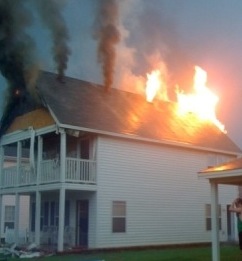
Lightning is the “visible discharge of static electricity within a cloud, between clouds or between the earth and a cloud,” as defined by Underwriters Laboratories. Lightning is unpredictable and a serious threat to buildings and their occupants virtually everywhere.This house in Fayetteville, AR, was ignited by lightning

Facts about lightning:

  • Benjamin Franklin invented the first lightning rod in 1752 –- a kite outfitted with a metal key — while waiting impatiently for the completion of a church on top of which he would mount a lightning rod.
  • Lightning comes up from the earth –- as well as down from the cloud — from high vertical features such as chimneys and trees.
  • A typical lightning bolt carries 50,000 amps, tens of millions of volts, and can reach 50,000° F. “Superbolts” may be 100 times more powerful than typical bolts, and travel much farther, too; one such superbolt went from Waco to Dallas, Texas, after having traveled about 118 miles.
  • According to the National Weather Service, of the 34 people killed by lightning in the United States in 2009, all were outside when they were struck. Thus, homes provide a great deal of safety against lightning strikes. Interestingly, the same report indicates that 82% of lightning casualties were male.
  • Permanent injuries caused by lightning strikes are predominantly neurological and can include sleep disorders, attention deficits, numbness, dizziness, irritability, fatigue, depression, and an inability to sit for long periods of time.
  • Between 2002 and 2005, lightning caused an annual average of $213 million in property damage.

PROTECT YOUR HOME FROM LIGHTNING

Types of dangers from lightning to houses and occupants:

  • damaged appliances from power surges;
  • electrocution risk for occupants;
  • fire risk to the building and occupants;
  • damage to the structure from water used to douse the fire by the fire department; and
  • damage to the structure and endangered health from mold colonies, if the building was not dried quickly following fire suppression.

Corrugated Stainless Steel Tubing (CSST)

CSST is a relatively new type of gas tubing that has been widely installed in houses and in commercial applications in recent years. Its small diameter makes it flexible and relatively easy to install when compared with traditional, rigid, heavy-walled pipes, although this same quality is believed to make it susceptible to fire due to lightning strikes. Lightning that travels down the CSST can burn holes in the tubing and allow gas leakage and fire. In the worst cases, gas leaks have led to disastrous gas explosions. CSST has been found to be susceptible to damage from direct and even nearby lightning strikes.
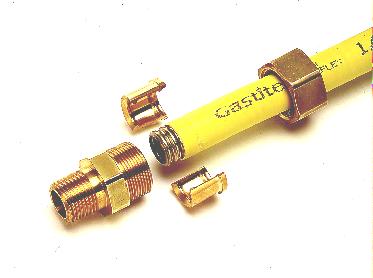
This steal pipe, made by Titeflex, is believed to contribute to fire risks following a lightning strike

These claims have lead to a class-action lawsuit against manufacturers of CCST (Titeflex, Ward, OmegaFlex and Parker Hannifin) installed in homes as of September 5, 2006. Plaintiffs claim that the CSST tubing is not thick enough to prevent becoming damaged in the event of a lightning strike, and that CSST manufacturers failed to warn consumers about such dangers. The defendants claim that CSST is safe if properly installed, in accordance with local codes and the manufacturers’ instructions. According to the Lightning Protection Institute, dangerous CSST has been installed in more than a million homes in the United States.

Identification of CSST

Typically, these products may be visible in attic spaces, along floor joists, above basements, or connected to exposed appliances, such as water heaters. The piping can be identified by its manufacturer’s mark, each of which are listed below:

  • OmegaFlex’s CSST is stamped with the marks “TRACPIPE” or “COUNTERSTRIKE.”
  • Parker Hannifin’s CSST is stamped with the mark “PARFLEX.”
  • Titeflex’s CSST is stamped with the mark “GASTITE.”
  • Ward’s CSST is stamped with the mark “WARDFLEX.”
Additional bonding to ground is recommended for houses with CSST.

Safety tips for clients during thunderstorms:

  • Unplug sensitive appliances, such as computers and telephones, from electrical outlets and phone lines. Surge protectors are helpful, but they should not be relied upon during a storm.
  • Stay off corded phones, computers, and other electronic equipment that put you in direct contact with electricity. If you are unable to unplug them, turn them off. Lightning may strike nearby electric or phone lines and enter your home.
  • Unplug other appliances, such as air conditioners.
  • Stay away from windows.
  • Avoid washing your hands, bathing, doing laundry, and washing dishes — activities that put you in direct contact with running water.

Lightning Protection Systems

Lightning protection systems are devices intended to divert lightning into low-resistance paths to or from the earth and away from non-conducting parts of a structure. For specific inspection instructions regarding these systems, see the National Fire Protection Agency’s NFPA-780.

Lightning Rods
Metal rods are fastened to the building to intercept electric discharges that might otherwise strike a building component itself, such as a chimney or metal roof. Electrical discharges striking the air terminal are directed through metal conductors to a grounding system and thence into the earth.
Controversy has existed for centuries concerning whether lightning rods should have blunt or sharp tips. Recent studies have found that moderately blunt metal rods are better lightning-strike receptors than sharper rods or very blunt rods.
In summary, lightning can be very dangerous to homes and occupants, although devices and measures exist to limit this danger.

Home Service Grounding Electrodes

Home Service Grounding Electrodes

by Nick Gromicko, Rob London and Kenton Shepard
Electrical grounding systems divert potentially dangerous electrical currents by providing a path between a building’s service boxGrounding Rod and the earth. Lightning and static electricity are the most common sources of dangerous or damaging charges that can be dissipated through a grounding system. Grounding electrodes are connected to the building’s electrical system through grounding electrode conductors, also known as ground wires. A number of different metal alloys can function as grounding electrodes, the most common of which are the focus of this article.
Requirements for electrodes and ground wires:
  • Aluminum has a tendency to corrode and should not be used in ground wires unless they are insulated. Moisture and mineral salts from masonry are common causes of corrosion to uninsulated aluminum. It is also a poorer conductor than copper. Aluminum wires in grounding systems are not permitted in Canada.
  • Since grounding electrodes are not insulated, they can never be made of aluminum.
  • If more than one electrode is present, they must be connected to each other with a bonding jumper.

Common Types of Grounding Electrodes Grounding Rods

The most common form of grounding electrode is a metal rod that is hammered into the ground so that its entire length is submerged. InterNACHI recommends that the rod be inserted vertically and in one piece, but this is not always possible in rocky areas. If the rod is hammered into sub-surface rocks it might become scratched and lose its cladding. Rust can accumulate on exposed iron or steel and degrade the conductive capacity of the rod. Unfortunately, this rust will rarely be visible to an inspector.
Electricians have been known to cut the rod when they have difficulty inserting its entire length beneath the ground. This practice violates code and can be a safety hazard. Inspectors should look for the following signs that indicate that a grounding rod has been shortened:
  • Rust at the rod’s top. Grounding rods have a corrosion-resistant coating but are usually made of steel or iron and are vulnerable to rusting at any location that the rod is cut.
  • Most rods have an etched label on their top. If this label is missing it is likely that the rod has been cut.

Inspectors should bear in mind that utility companies sometimes allow ground rods to be shortened. A qualified electrician can test whether a shortened rod is an adequate grounding electrode.

If accessible, inspectors should check the condition of the clamp that connects the grounding rod to the ground wire. Clamps should be made of bronze or copper and be tightly fastened. Requirements for rod length, thickness, and protective coating are addressed in the 2006 International Residential Code (IRC) as follows:

Rod and pipe electrodes not less than 8 feet (2438 mm) in length and consisting of the following materials shall be considered as a grounding electrode:
  1. Electrodes of pipe or conduit shall be not smaller than trade size ¾ (metric designator 21) and, where of iron or steel, shall have the outer surface galvanized or otherwise metal-coated for corrosion protection.
  2. Electrodes of rods of iron or steel shall be at least 5/8 inch (15.9 mm) in diameter. Stainless steel rods less than 5/8 inch (15.9mm) in diameter, nonferrous rods or their equivalent shall be listed and shall be not less than 1⁄2 inch (12.7mm) in diameter.

Notes

  • Although the 2006 IRC does not mention whether the rod may be driven at an angle, the 1998 California Electrical Code allows for a maximum oblique angle of 45 degrees from the vertical.
  • An electrician can install two grounding rods if necessary. They should be at least 6 feet apart from one another.
  • In Canada, grounding rods should be 10 feet long and two are required.

Concrete-Encased Electrodes (Ufer Grounds)

This electrical grounding technique was invented during World War II in Arizona, and is commonly called “Ufer” after its creator, Herbert G. Ufer. The United States Army was concerned that lightning or static electricity could cause the accidental detonation of explosives that were stored in igloo-shaped vaults. The desert climate restricted the usefulness of grounding rods, which would have to be driven hundreds of feet into the dry earth in order to be effective. Ufer advised the military to connect ground wires into the concrete-encased steel reinforcement bars (re-bar) of the bomb vaults in order to dissipate electricity effectively into the ground. Testing confirmed his theory that the relatively high conductivity of concrete would allow electric current to dissipate into a large surface area of earth. The Ufer method is more common in newer residential construction and requires a metal frame. It might be difficult for an inspector to detect this type of electrode. The 2006 IRC details Ufer grounds as follows:
An electrode encased by at least 2 inches (51 mm) of concrete, located within and near the bottom of a concrete foundation or footing that is in direct contact with the earth, consisting of at least 20 feet (6096 mm) of one or more bare or zinc-galvanized or three electrically conductive coated steel reinforcing bars or rods of not less than 1/2 inch (12.77 mm) diameter or consisting of at least 20 (6096 mm) feet of bare copper conductor not smaller than 4 AWG shall be considered as a grounding electrode. Reinforcing bars shall be permitted to be bonded together by the usual tie wires or other effective means.
Metal Underground Water Pipes
A building’s plumbing system can be connected to the ground wire and function as a grounding electrode. For some time, this was the only mandatory grounding electrode type and it was generally preferred over other methods. As of 1987, however, this method became the only one that must be supplemented with another type of electrode. This transition is due to the increased popularity of non-conductive dielectric unions and plastic pipes. When plumbing has been replaced with plastic pipes a notice is required to be placed at the electrical service panel that states that there is a non-metallic water service. Inspectors will not be able to tell if outdoor water pipes that run to street water mains have been replaced with plastic components.
Inspectors should check for the following:
  • Ground wires should be firmly attached to water pipes close to the point of entry to the building. A ground wire that is loosely tied around a pipe is inadequate.
  • Gas pipes should never be used as grounding conductors. They usually are made of plastic at the exterior of the home and carry flammable gases that may ignite if exposed to electrical current.

The 2006 IRC states the following about water pipe electrodes:

A metal underground water pipe that is in direct contact with the earth for 10 feet (3048 mm) or more, including any well casing effectively bonded to the pipe and that is electrically continuous by bonding around insulating joints or insulating pipe to the points of connection of the grounding electrode conductor and the bonding conductors, shall be considered as a grounding electrode. Interior metal water piping located more than 5 feet (1524 mm) from the entrance to the building shall not be used as part of the grounding electrode system or as a conductor to interconnect electrodes that are part of the grounding electrode system.
Less Common Grounding Electrodes
The previously mentioned grounding electrodes constitute the vast majority of grounding systems that inspectors will encounter. The two electrodes described below are far less common, although they are recognized by the IRC. Inspectors might not be able to verify their presence. The 2006 IRC explains them as follows:
Plate Electrodes
A plate electrode that exposes no less than 2 square feet (0.186 m2) of surface to exterior soil shall be considered as a grounding electrode. Electrodes of iron or steel plates shall be at least 1⁄4 inch (6.4mm) in thickness. Electrodes of nonferrous metal shall be at least 0.06 inch (1.5mm) in thickness. Plate electrodes shall be installed not less than 30 inches (762 mm) below the surface of the earth.
Ground Ring Electrodes
A ground ring encircling the building or structure, in direct contact with the earth at a depth below the earth’s surface of not less than 2.5 feet, consisting of at least 20 feet of bare copper conductor not smaller than No. 2 shall be considered as a grounding electrode.
In summary, a variety of home service grounding electrodes can be used to safely route unexpected electrical charges away from places that they can cause harm. Inspectors should be aware of how they differ from one another and be prepared to spot defects.

Static Electricity

Static Electricity

by Nick Gromicko and Rob London

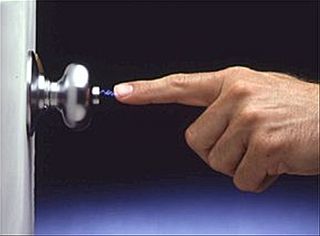
Static discharges can be annoying

Static electricity is the buildup of electrical charges on the surface of non-conducting materials. It is called “static” because, unlike a home’s electrical system, static electricity has almost no current. Static typically forms when two materials come into contact, and some of the charges redistribute by moving from one material to the other. This leaves a net positive charge on one material and an equal negative charge on the other, both of which will remain if the two materials separate. If the net charges grow faster than a material can dissipate them, an electrostatic charge builds up. The excess charge can suddenly neutralize by a flow of charges to the surroundings, known as an electrostatic discharge or static spark. By super-heating the surrounding air and causing it to rapidly expand, the discharge is both visible and audible.

Interesting Facts About Static Electricity

  • Ordinary household static can have voltages many times greater than the home’s electrical system. A static shock is not ordinarily dangerous, though, because the current is comparatively low.
  • Scientists believe that lightning is caused by the exchange of charges between ice particles within clouds. Lightning is thus a scaled-up version of the static discharges with which we are accustomed.
  • During the Great Depression, swirling dust-bowl winds caused tremendous buildups of static electricity that were powerful enough to knock a Dust bowl "black blizzards" created immense static charges person unconscious. Blue flames erupted from metal fences, electrical systems in cars shorted out, and people would drag chains in order to offset the electrostatic charge.

Static Electricity Hazards

Static may create sparks and shocks, and cause materials to cling together. These phenomena are typically merely annoying, but, under the right circumstances, they can cause significant damage to life and property. Specifically, static electricity can cause:

  • fires and explosions, where flammable vapors and dust clouds can occur. Static has caused deadly explosions in buildings that filled with natural gas;
  • nuisance shocks. While typically harmless, these shocks can cause significant distress to building occupants. In rare situations they can cause bodily harm, such as when hot fluids are handled and a static shock causes inadvertent recoil; and
  • damage to sensitive electronic equipment, such as computers and cell phones. One static-plagued InterNACHI member reported that she managed to disable the Caller ID feature on her phone by repeatedly “zapping” it, and she also put her microwave to sleep. Beware that even mild or imperceptible static discharges may be powerful enough to render a computer inoperable, or even erase its hard drive.

Static Limitation Strategies

There are many variables that contribute to static electricity in homes, including the physiological makeup of an individual, their walking habits and shoes, carpet materials and construction, and the amount of moisture in the air. To help ensure that static-friendly conditions are avoided, inspectors can pass the following tips on to their clients:

  • Humidify the living space. When the air is humid, water molecules collect on the surfaces of household materials, which prevents the buildup of electrical charges. Humidity levels of 40 to 50% are usually sufficient to prevent static discharges, and you can check the humidity with an inexpensive humidity meter from a gardening shop. Beware that high humidity levels will promote the growth of mold, which can be a far more dangerous condition than excessive static electricity.Anti-static wrist wrap  Try these other tips to increase indoor humidity:
    • Use a humidifier.
    • Incorporate a variety of leafy indoor plants. Plants effectively turn liquid water into water vapor, similar to a mechanical humidifier.
    • Simmer a pot of water on the stove, but don’t forget that the stove is on!
  • Consider your clothing.Use an anti-static hand lotion if your hands are dry.
    • Switch to natural fibers, since synthetics pick up more of a static charge. If you must wear synthetic fibers, do not allow them to touch; separate nylon and polyester layers with cotton, for instance.
    • Wear leather-soled shoes. Also, try not to drag your feet on the carpet.
  • Spray carpet surfaces with an anti-static product. Fabric softener has anti-static properties, and it may be diluted and then sprayed onto the carpet. These chemicals eliminate buildup of static electricity by making the material itself slightly conductive, either by being conductive itself, or by absorbing moisture from the air. These products may be sticky and attract dirt, however.
  • Wear an anti-static wrist wrap. These antistatic devices are used to prevent electrostatic discharge by safely grounding a person. They consist of a stretchy band of fabric woven with conductive fibers made from carbon or carbon-filled rubber.
In summary, static electricity can cause distress for building occupants, but it can be controlled.
  

Electricity: Origins, Consumption and Costs

Electricity: Origins, Consumption and Costs

by Nick Gromicko and Rob London
Electricity — the flow of electrical power or charge — is a basic product of nature and one of the most widely used forms of energy in homes. It is generated from energy sources found in the environment, such as sunlight, coal and wind. China's Three Gorges Dam is the largest power plant of any kind.

Houses themselves are, in effect, electrical devices, fed directly from utilities to power almost all appliances, from heaters to hair dryers. It is thus valuable for inspectors to have some understanding of where electricity comes from, what it powers, and what variables contribute to its costs.

Facts and Figures

  • The cost required to generate electricity varies minute by minute, reflecting its real-time demand throughout the day. Most consumers, however, pay rates based on average prices over long periods, saving them from volatile price fluctuations.
  • According to 2008 statistics, Tennessee had the highest per-capita annual energy consumption of any state in the U.S., coming in at 15,624 kWh, and Maine had the lowest at 6,252 kWh. The national average electricity consumption for a U.S. residential utility customer was 11,040 kWh.
  • In 1879, the California Electric Light Company in San Francisco became the first company in the United States to sell electricity. They produced and sold enough electricity to power 21 lights.
  • Compared to other sources of energy, such as natural gas, households are predicted to become increasingly reliant on electricity over the next quarter-century. China, India and smaller developing Asian countries will experience the highest growth in demand as they switch from outmoded forms of energy.
  • The Three Gorges Dam in China is the world’s largest electricity-generating plant of any kind. When it opens in 2011, the $26 billion dam will have a maximum operating capacity of 22.5 GW, enough to power 3% of all households in China, which is equivalent to its entire current wind-energy fleet.

How is Electricity Used in Homes?

According to national averages, electricity is consumed by American homes in the following distribution:

  • heating:  29%;
  • cooling:  17%;
  • water heating:  14%;
  • large appliances, such as refrigerators, dishwashers, clothes washers and dryers:  13%;
  • lighting:  12%;
  • other household appliances, including stoves, ovens and microwaves, and smaller appliances, such as coffee makers and dehumidifiers, power adapters, and ceiling fans:  11%; and
  • electronics, such as computers, TVs and DVD players:  4%.

Prices by State

Prices vary by location due to proximity to power plants and fuels, local fuel costs, and pricing regulations. The three states with the highest average prices for electricity in 2008 were:

  • Hawaii at 29.20¢ per kilowatt hour (kWh). Electricity prices are high in Hawaii because most of the electricity there is generated from petroleum;
  • Connecticut at 16.95¢ per kWh; and
  • New York at 16.74¢ per kWh.

States with the lowest average prices for the same year were:

  • West Virginia at 5.59¢ per kWh, which is a state that mines some of the country’s richest anthracite coal veins;
  • Wyoming at 5.68¢ per kWh, which has a large bituminous coal-mining industry, along with natural gas production; and
  • Idaho at 5.70¢ per kWh. Electricity in Idaho is inexpensive because of the availability of low-cost hydroelectric power from federal-owned dams.

What Raw Materials Go Into Producing Electricity?

Electricity consumed in homes and businesses in the United States is generated from the following sources:Chinese coal

  • coal, which produces 44.9 % of all power in the U.S.  Along with water, coal was used in the first power plants, and it remains the cheapest known raw material used to produce electricity. Rhode Island has no coal-generated electricity, while Wyoming’s electricity is 94.5% coal-derived.
  • natural gas, which accounts for 23.4% of the country’s total power. For an equivalent amount of heat, burning natural gas produces significantly less carbon dioxide than burning coal or petroleum.
  • Nuclear power, which produces 20.3% of all power used in the U.S., is a sustainable energy source because it releases no greenhouse gases, although opponents are concerned about security and waste disposal.
  • hydroelectric power, which has 6.9% of the nation’s share. Worldwide, hydroelectricity accounts for 20% of all electricity generated, and nearly all power produced by renewables in general. While touted as producing no direct waste and requiring few personnel on site at dams during normal operation, some of the most deadly manmade disasters have been caused by dam failures used for hydroelectric power generation.
  • other renewables:  3.6%. Generation of electricity from the sun, wind, and other renewable sources has been constrained by technological limitations and stalled by local politics, although this sector is growing rapidly. Maine receives more than 26% of its electricity from renewable energy sources, while Tennessee receives almost none.
  • petroleum produces the least, at 1%. While it meets nearly half of the U.S.’s energy needs, petroleum is rarely used to generate electricity.

Other countries have significantly different electricity source profiles. France, for instance, generates almost all of its electricity using nuclear power.

In summary, electricity is produced from a number of different sources, each with its own upsides, and financial and environmental costs.
  

Electrical Terms

Electrical Terms

by Nick Gromicko and Rob London
Inspectors should understand electrical concepts in order to perform competent electrical inspections. This article seeks to clarify some elementary electrical terms and concepts that are sometimes confused.
 
Basic Electrical Measurement Units 
  • Voltage, measured in volts (V), is the measure of potential energy per unit of charge. Using a “water-in-pipes” analogy, voltage in the electrical system is similar to water pressure in a plumbing system. High “pressure” or voltage in an electrical conductor means that the conductor is capable of delivering a lot of electricity to the user. Most household current is “pushed” at 120 or 240 volts, although these values are nominal, and considerable variation occurs. Most (but not all) modern electrical equipment can handle small voltage variations and differences without any problem. For example a 240V appliance can usually handle 216V fine. Sensitive electronic equipment may require the installation of a voltage stabilizer.
  • Resistance, measured in Ohms (Ω), is the measure of the restriction of flow of electrical current through a material. All materials, except superconductors, have a resistance above zero. Metals have lots of free electrons; therefore, they have a low resistance, so they are used in wiring. In an electrical circuit, it is important to use cables that have a low enough resistance to adequately transfer the necessary current for the application. Thick wires are required for high-power applications because these wires have low resistance.
    The filament of an incandescent light bulb has high reistance to electric current, which causes it to glow
    Consider the incandescent light bulb. Thomas Edison and other early researchers discovered that if resistance in a wire is great enough, the wire heats up and glows and produces usable light. They used this knowledge to create the incandescent bulb, in which a current is applied to a highly resistant, ultra-thin filament, causing it to glow. Standard copper wires, unlike light bulb filament, have little electrical resistance. Yet, even copper wire can glow and start a fire when it is too resistant for the current running through it.
  • Amps are a measure of the number of electrons flowing in the same direction along a conductor. Also known as the current, this value is proportional to the applied voltage and the resistance of the material. For example, if a light bulb is connected to a battery, the current flowing through it would be calculated using I = V / R, where I is the current, V is the voltage of the battery, and R is the resistance of the light bulb. This relationship is known as Ohms Law. You can see from this example that in order to double the current flowing in the bulb, you would need to double the voltage applied to it.
  • Power is a measure of the overall amount of work being done in a system in relation to time (or energy used per second). In an electrical system, power can be calculated by using the formula P = VI. From this, you can see how the voltage and current in a system relate to the overall amount of power used. The unit of a Watt (W) is equivalent to joules per second; therefore, one Watt is equal to one joule per second.

Alternating Current and Direct Current

  • Alternating current (AC) is almost universally used for a home’s electrical power. The amount of voltage applied to an AC circuit is constantly changing from zero to a maximum and back to zero in one direction, and then from zero to maximum and back to zero in the other direction. Because voltage is the pressure that causes current to flow, the current will also change from zero to maximum. Each complete change from zero to maximum to zero is called one hertz (Hz). Hertz is often abbreviated as “cps” (cycles-per-second) or Hz, which you will see marked on some electrical devices.
  • Direct current is most commonly found in homes in the form of electrical energy stored in batteries. In a DC circuit, the amount of voltage and the direction of application are constant. The amount of voltage is determined by the type and size of the battery. The direction of current flow is also constant and, as in AC circuits, the amount of current flow is determined by the resistance. Batteries convert chemical energy to electrical energy. The chemical energy can be in wet form, as in a car battery, or in dry form, as in batteries used for flashlights, toys and portable music devices. Some batteries are designed to be recharged from an AC source. The voltage from all batteries, unless recharged, will gradually decrease. AC power can be converted to DC power for some uses in the home. The conversion is performed by a device called a rectifier or current converter.

Which one is dangerous:  voltage or current?

A common adage goes, “It’s not voltage that kills, it’s current!”  This is essentially correct. However, if voltage presented no danger, no one would ever print and display signs saying: “DANGER — HIGH VOLTAGE!” It is electric current that burns tissue, freezes muscles, and fibrillates hearts. However, electric current doesn’t just happen on its own — there must be voltage available to motivate electrons to flow through a victim. Static electricity can have a very high voltage even though it's usually harmless

High voltage is not inherently dangerous. Track your feet across carpet on a dry winter day and you will charge your body to several thousand volts. If you then touch metal, the resulting static discharge will have a voltage many times greater than a typical home’s electrical system, yet you will be perfectly safe because the current is not sustained.

A person’s body presents resistance to current. The following two variables partly determine whether an electric shock will cause bodily harm:

  • individual body chemistry. Some people are highly sensitive to current, experiencing involuntary muscle contraction with shocks from static electricity. Others can draw large sparks from discharging static electricity and hardly feel it, much less experience a muscle spasm.
  • where contact is made with the skin, such as from hand-to-hand, hand-to-foot, foot-to-foot, hand-to-elbow, etc. An electric shock that travels from one hand to the other will pass through the heart and potentially lead to cardiac arrest. The same current, if it travels through just one hand, will not be as dangerous. Also, contact with a wire by a sweaty hand or open wound will offer much less resistance to current than contact made by clean, dry skin. Sweat and blood are rich in salts and minerals, which make them excellent conductors.

In summary, electrical terms such as volts, amps, ohms and watts describe distinct electrical phenomenon, although they are dependent on one another.