Author Archives: bwisnewski

“Cool” Energy-Efficient Roofs

“Cool” Energy-Efficient Roofs

by Nick Gromicko, Rob London and Kenton Shepard
Cool roofs, also known as reflective roofs, are roof surfaces designed to reflect radiation from the sun, reducing heat transfer intoCool roof equipped with a solar panel. Not all cool roofs are white. the building.

How do they differ from conventional roofing products?

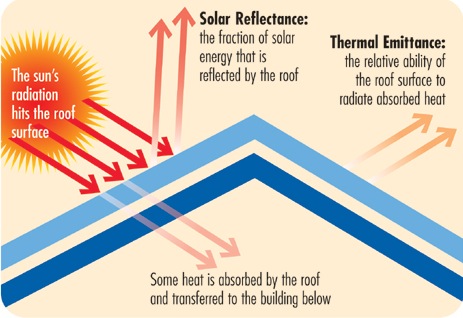
Unlike most North American asphalt roofs, cool roofs are specially engineered to reflect much of the sun’s radiant energy back into space instead of transferring it as heat into the building below. The two basic characteristics that determine the performance of a cool roof are solar reflectance and thermal emittance. Both properties are rated on a scale from 0 to 1, where 1 is the most reflective or emissive. Although there is no industry-wide definition of a cool roof, the EPA’s Energy Star Roof Products Program has established a minimum standard, requiring that cool roof products have an initial reflectance of at least 0.65, and a reflectance of at least 0.5 after three years of weathering. By contrast, conventional asphalt roofs have a reflectivity of between 0.06 and 0.26, resulting in large amounts of heat transfer into the building’s interior.

The use of cool roof products offers the following benefits: 

  • increased lifetime of roofing materials. Cool roofs do not experience thermal cycling as much as conventional roofs. Thermal cycling can deteriorate the bond between shingles and asphalt, potentially causing premature failure;
  • energy savings. According to the U.S. Department of Energy, some reflective roof products can lower roof surface temperature by up to 100 degrees and can reduce peak cooling demand by as much as 15%. Cool roofs may result in increased heating costs during the winter, but this increase is greatly outweighed by the cooling energy savings achieved during summer;
  • reduction of the “heat island” effect. This is the tendency for metropolitan areas to be warmer than their surroundings due to the use of building materials that retain heat. Studies have shown that this phenomenon increases the risk of death during heatwaves and decreases air quality by increasing the production of pollutants, such as ozone;
  • lower peak electrical demand. The maximum energy load an electric utility experiences in order to supply customers instantaneously, which generally occurs in late afternoons during summer as businesses and residences Solar reflectance and thermal emittance of a cool roofturn up their air conditioners, is reduced by the implementation of reflective roofs; and
  • utility rebates, in some areas. Generally, utilities pay back a certain percentage — usually about $0.20 per dollar — after installation and documentation. Their motivation for these incentives is to reduce the intensity and likelihood of blackouts and brownouts.

Cool Roof Product Types

InterNACHI believes that products generally fall into a few categories:  single-ply materials, and coatings. Single-ply materials are large sheets of pre-made roofing that are mechanically fastened over the existing roof, and then sealed at the seams. Coatings are applied using sprays, rollers or brushes over an existing clean, leak-free roof surface. “Cool” versions of asphalt shingles are also available.
These products include:
  • Coatings:  Roof coatings can be divided into two categories: field-applied and factory-applied. Field-applied coatings are applied directly onto the roof surface, either on a new roof assembly or over an existing roof surface (and can be applied over the top of just about anything, as long as the correct coating is selected). Factory-applied coatings are applied during the manufacturing process. Examples of factory-applied coatings include coatings applied to metal, and glazes that are applied to tiles.
  • Single-Ply:  Single-ply roofing is laid down in a single layer over a low or steep-sloped roof. The single-ply membrane can be loose-laid and weighted down with ballast or pavers, or firmly set on the roof and attached with mechanical fasteners or adhesives. Single-ply thermoplastic is a flexible sheet membrane which consists of compounded plastic polymers. When heat is applied onto the surface, the single-ply thermoplastic seams are melded together, making the material seamless and effective. Most thermoplastics are manufactured to include a reinforcement layer, such as polyester or fiberglass, for additional durability and strength. There are various types of single-ply thermoplastic, such as polyvinyl chloride (PVC) and thermoplastic polyolefin (TPO). PVC tends to be more expensive than TPO, but PVC is well-known for long-term performance and is naturally fire-retardant. TPO is a blend of polymers that can contain flame-retardants or UV absorbers.
  • Asphalt Shingles:  Although a challenging technical issue, some manufacturers have created dark-colored asphalt shingles that look almost identical to conventional shingles, yet they qualify as cool roof products. They accomplish this feat through the use of engineered pigments that reflect high amounts of invisible wavelengths, namely, infrared.
In summary, cool roofs are coatings and sheets that are applied to roofs to make them reflect the sun in order to keep building’s interior cooler and more energy-efficient, which is especially important during summer months and in warmer climates.

Closing Costs

Closing Costs

by Nick Gromicko and Rob London
When a home is sold, there is a point in the transaction known as the closing, when the title to the property is transferred to the new owner. The buyer and/or seller commonly Closing costs can be substantialincur miscellaneous fees, which are collectively known as closing costs. These fees can be significant, averaging approximately 2% to 4% of the purchase price, although they may be as much as 8%.
Take a look at the following guide to get a better idea of what buyers and sellers are expected to pay upon closing:
  • inspection fees. Lenders may require a termite inspection or an analysis of the structural condition of the property in order to assure that a home will be reliable collateral to secure against a loan. An inspection of the septic system and water supply tests may also be required in rural areas. Always be sure to hire an InterNACHI inspector to get the most out of an inspection.
  • points. This one-time, prepaid interest is paid by the buyer to the lender as a way to reduce the rate of interest on the mortgage loan. One point equals 1% of the loan’s principal. For example, one point on a $200,000 loan is $2,000. If the borrower plans to live in the home for a long time, it might be to his advantage to negotiate for more points. Points can be financed by adding them to the loan, or they may be paid upfront and deducted from the current year’s income taxes.
  • title search fees. This one-time fee is used by buyers and lenders to make sure that the seller legally owns the property, and that the property has no outstanding liens or restrictions for use of which the buyer is unaware. If divorces, contested wills or court judgments are discovered during the title search, future complications can be avoided. Anyone may perform a title search, but borrowers commonly hire an attorney or title company to perform a thorough search.
  • title insurance. Title insurance policies are purchased to protect the lender against an error in the results of the title search, which would otherwise endanger the lender’s investment in the borrower’s mortgage. In case the title is challenged in court, title insurance will reimburse the insured up to a predetermined dollar amount.
  • appraisal fees. Lenders want to be assured that the property to be purchased is worth at least as much as the amount of the loan. An appraisal, performed by a licensed professional appraiser, will determine the fair market value of the property. The requirement of an appraisal may be waived if one has been performed recently.
  • recording fees. These are paid to the clerk and recorder’s office of the county where the property is located for the service of entering an official record of the change of a property’s ownership.
  • application fee. This cost covers the assessment of the buyer’s credit report and the initial processing fee of the mortgage loan. The cost is several hundred dollars.
  • loan origination fee. This umbrella charge covers the evaluation and preparation of the loan, which may include fees charged by the lender’s attorney or notary. The total cost can be several thousand dollars, although it can be reduced somewhat by a larger down payment.
  • prepaid interest. While the new homeowner’s first mortgage payment may not be due for some time after closing, interest starts accruing immediately after closing. For instance, if the deal closes on October 11th, the homeowner will owe interest for the 20 days preceding the first mortgage payment.
  • prepaid property insurance. Lenders typically require that the first year’s premiums of property insurance be paid in advance.
  • property survey fee. A survey is performed of the lot and its structures to confirm the deed’s legal description of the property, including the property’s dimensions, and to check for encroachments, and verify that the house and other structures are where the seller says they are.
  • homeowners association (HOA) dues. If the property is part of an HOA, the buyer will need to cover, in advance, the requisite fees for the part of the remaining year that they will own the property.
  • property taxes. Like HOA fees, buyers must pay upfront the share of the property taxes for which they are proportionally responsible.

Tips for Reducing Closing Costs

  • Home buyers short on cash can roll the closing costs into the mortgage loan. It is also possible for the lender to pay the closing costs in exchange for a higher interest rate.
  • Choose a closing date that’s near the end of the month, as this will save money on prepaid interest.
  • Negotiate with the seller of the property to help pay for some of the closing costs.
In summary, closing costs include a variety of miscellaneous fees paid by the home buyer and/or seller.
 

Central Vacuum Systems

Central Vacuum Systems

by Nick Gromicko and Rob London 
A central vacuum system (sometimes called a whole-house vacuum system) is a cleaning device installed throughout a building. Located in the garage or basement, a canister receives dust and debris sucked by the force of a motor from wall outlets, which are located for the homeowner’s convenience.
Central vacuum systems are powerful, yet expensive alternatives to portable vacuum units
While many Americans are unfamiliar with central vacuums, they are not new inventions; the idea dates back as far as the 1850s in Sweden, where horse-powered fans were used to create suction through in-wall plumbing. Horses were later replaced by servants, who pumped giant bellows or pedaled stationary bicycles, until electric motors eventually took over. Shortly thereafter, however, portable vacuum cleaners became available, and central vacuum systems were largely forgotten due to their relative expense. Their hibernation ended by the 1990s when growing house sizes and concerns over air quality combined with the availability of cheaper plastic piping, more powerful motors and refined filtration systems. Yet, even today, American homes are dependent on portable vacuum cleaners, in contrast with Canadian and Scandinavian homes, where central vacuum systems are more common.
Central vacuum systems boast some advantages over portable units, some of which are as follows:
  • They are long-lasting. Their motors can handle more usage than typical portable units. Warranties, too, are usually longer for central units.
  • They are quiet. Because the motor is located outside the living area, users are not subjected to noise created by the motor, which can be excessive and stressful.
  • They can be retrofitted into older houses, or built into new construction.
  • They are a good investment. Just as a kitchen renovation or new deck will make a home more valuable, many buyers will pay extra for a house equipped with a central vacuum.
  • They are hypo-allergenic. Unlike portable vacuums, which recycle air back into the room, dust-laden air is blown into the outdoors from central vacuum systems. One comprehensive study conducted at the University of California at Davis’ School of Medicine compared portable to central units and concluded that “a central vacuuming system would best provide [allergen removal] as it would be installed outside the living area of the dwelling and/or vented outdoors.”
  • The system is easy and safe to use. There is no heavy equipment to carry from room to room, and no electric cords to trip over or catch on furniture.

Types of central vacuum cleaners available include:

  • cyclonic, in which air is spun in a canister and exhausted to the outdoors. Location is critical for these units, as it is possible for exhausted, debris-laden air to find its way back into the house through open windows. The filter must be removed and cleaned periodically;
  • inverted filter, in which the dirt enters the vacuum canister amidst a tornado-like swirl of air. The canister must be emptied periodically, and always outside of the home. Allergy sufferers may find disposal unpleasant, as mold and other debris become airborne; and
  • disposable bag, in which dirt is sucked into a paper bag in the same fashion as for portable units. This is perhaps the cleanest and most hygienic method available, as mold spores, bacteria and other debris are physically separated and stored in a bag from which they cannot escape.
The disadvantages of central vacuum systems include:
  • price. A good system can cost $1,500, which is significantly more expensive than even premium portable vacuum cleaners;
  • damage caused by items sucked up inadvertently. With greater power comes higher risk that large items will be sucked up, potentially causing damage to the unit. Tales abound of units becoming jammed or broken when they swallow, often at the hands of children, broken jars of jelly, toilet water, and even pet birds. Portable units are usually too weak to readily suck up items that can cause them to break;
  • a system compromised by weak suction.  Such a problem may be due to obstructed pipes or exhaust, an excessively dirty filter, or a full canister that needs to be emptied. If the unit does not operate at all, the motor might be broken, a breaker may have tripped, or the wiring may be defective.
In summary, central vacuum systems are convenient, powerful and expensive home-cleaning devices.

Central Air-Conditioning System

Central Air-Conditioning System Inspection

by Nick Gromicko and Rob London
A building’s central air-conditioning system must be periodically inspected and maintained in order to function properly. While an annual inspection performed by a trained professional is recommended, homeowners can do a lot of the work themselves by following the tips offered in this guide.Exterior Condenser Unit
 
Clean the Exterior Condenser Unit and Components
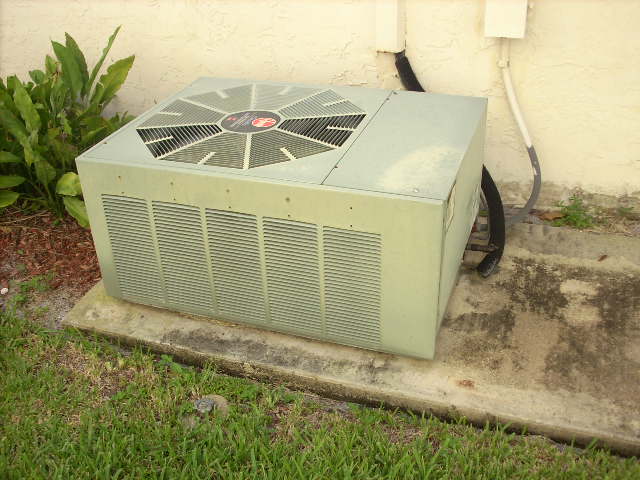
The exterior condenser unit is the large box located on the side of the building that is designed to push heat from the inside of the building to the outdoors. Inside of the box are coils of pipe that are surrounded by thousands of thin metal “fins” that allow the coils more surface area to exchange heat. Follow these tips when cleaning the exterior condenser unit and its inner components — after turning off power to the unit!
  • Remove any leaves, spider webs and other debris from the unit’s exterior. Trim foliage back several feet from the unit to ensure proper air flow.
  • Remove the cover grille to clean any debris from the unit’s interior. A garden hose can be helpful for this task.
  • Straighten any bent fins with a tool called a fin comb.
  • Add lubricating oil to the motor. Check your owner’s manual for specific instructions.
  • Clean the evaporator coil and condenser coil at least once a year.  When they collect dirt, they may not function properly.
Inspect the Condensate Drain Line
Condensate drain lines collect condensed water and drain it away from the unit.  They are located on the side of the inside fan unit. Sometimes there are two drain lines—a primary drain line that’s built into the unit, and a secondary drain line that can drain if the first line becomes blocked. Homeowners can inspect the drain line by using the following tips, which take very little time and require no specialized tools:
  • Inspect the drain line for obstructions, such as algae and debris. If the line becomes blocked, water will back up into the drain pan and overflow, potentially causing a safety hazard or water damage to your home.
  • Make sure the hoses are secured and fit properly.
Clean the Air Filter
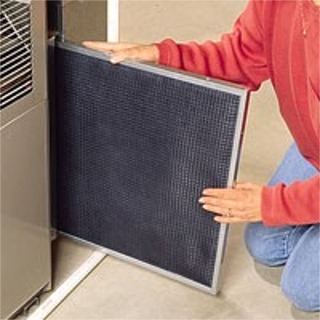
The air filter slides out for easy replacement
Air filters remove pollen, dust and other particles that would otherwise circulate indoors. Most filters are typically rectangular in shape and about 20 inches by 16 inches, and about 1 inch thick. They slide into the main ductwork near the inside fan unit. The filter should be periodically washed or replaced, depending on the manufacturer’s instructions. A dirty air filter will not only degrade indoor air quality, but it will also strain the motor to work harder to move air through it, increasing energy costs and reducing energy efficiency. The filter should be replaced monthly during heavy use during the cooling seasons. You may need to change the filter more often if the air conditioner is in constant use, if building occupants have respiratory problems, if you have pets with fur, or if dusty conditions are present.
 
Cover the Exterior Unit

When the cooling season is over, you should cover the exterior condenser unit in preparation for winter. If it isn’t being used, why expose it to the elements? This measure will prevent ice, leaves and dirt from entering the unit, which can harm components and require additional maintenance in the spring. A cover can be purchased, or you can make one yourself by taping together plastic trash bags. Be sure to turn the unit off before covering it.

Close the Air-Distribution Registers
Air-distribution registers are duct openings in ceilings, walls and floors where cold air enters the room. They should be closed after the cooling season ends in order to keep warm air from back-flowing out of the room during the warming season. Pests and dust will also be unable to enter the ducts during the winter if the registers are closed. These vents typically can be opened or closed with an adjacent lever or wheel.  Remember to open the registers in the spring before the cooling season starts.  Also, make sure they are not blocked by drapes, carpeting or furniture.
In addition, homeowners should practice the following strategies in order to keep their central air conditioning systems running properly:
  • Have the air-conditioning system inspected by a professional each year before the start of the cooling season.
  • Reduce stress on the air conditioning system by enhancing your home’s energy efficiency. Switch from incandescent lights to compact fluorescents, for instance, which produce less heat.
In summary, any homeowner can perform periodic inspections and maintenance to their home’s central air-conditioning system.


Carpeted Bathrooms

Carpeted Bathrooms

by Nick Gromicko, Rob London and Kenton Shepard
Carpeted bathrooms are bathrooms that have carpeted floors instead of traditional floor surfaces, such as tile or vinyl. Despite their tendency to foster mold and bacteria, carpets are sometimes installed in residential bathrooms for aesthetic purposes. Carpets should never be installed in bathrooms in commercial buildings.
Advantages of Carpets in Bathrooms
  • They make bathrooms appear more warm and inviting.
  • They are softer than tile and many people find them comfortable on bare feet.
  • Bathroom slip hazards are reduced. It is easier to slip on hard bathroom surfaces, such as tile, than on carpet.
  • Installation is generally quick and inexpensive.

Disadvantages of Carpets in Bathrooms

The pad beneath the carpet may soak up large amounts of moisture. Some of the common ways that carpets may come into contact with moisture in bathrooms include:
  • Steam from the shower will condense on the carpet.
  • Water splashes from the tub or shower.
  • Water sheds from shower/tub occupants as they step onto the carpet.
  • Water splashes out of the sink.
  • Water drips from the vanity.
  • Water leaks from the toilet.
The presence of moisture in the pad will lead to the growth of decay fungi on the wood or oriented strand board (OSB) sub-floor. The sub-floor will be decayed and weakened by mold. Mold also releases spores that can cause respiratory ailments, especially for those with certain health problems. Inspectors can use moisture meters to determine if there is excess moisture beneath a carpet.

In addition to potential mold growth beneath the carpet, bacteria can accumulate in carpeting that surrounds the toilet. Bacteria are contained in urine, which can be accidentally deflected onto the carpet.

Carpeted Bathrooms in Commercial Buildings
It is against code to install carpet in commercial bathrooms. The 2007 edition of the International Building Code (IBC) states the following concerning carpeted bathrooms in commercial buildings:
In other than dwelling units, toilet, bathing and shower room floor finish materials shall have a smooth, hard, nonabsorbent surface. The intersections of such floors with walls shall have a smooth, hard, nonabsorbent vertical base that extends upward onto the walls at least 4 inches (102 mm).
Recommendations for Clients
The following are recommendations that InterNACHI inspectors can pass on to clients who are experiencing urine- or moisture-related problems with their bathroom carpet:
  • Clean the carpet regularly to remove any mold or urine that may be present.
  • Keep the carpet as dry as possible. Various devices exist that prevent water from bypassing the shower curtain.
  • Install a bathroom fan, if one is not installed already. If a fan is installed, operate it more often.
  • Inspectors can inform their clients about why they are experiencing problems.
In summary, carpets installed in bathrooms can trap moisture and urine, substances that can cause structural damage and health problems.