Author Archives: bwisnewski

Three Deadly Mistakes

Three Deadly Mistakes Every Home Buyer Should Avoid

by Nick Gromicko, Rob London and Kenton Shepard
Deadly Mistake #1: Thinking you can’t afford it.Many people who thought that buying the home they wanted was simply out of their reach are now enjoying a new lifestyle in their very own homes.

Buying a home is the smartest financial decision you will ever make.  In fact, most homeowners would be broke at retirement if it wasn’t for one saving grace — the equity in their homes.  Furthermore, tax allowances favor home ownership.

Real estate values have always risen steadily.  Of course, there are peaks and valleys, but the long-term trend is a consistent increase.  This means that every month when you make a mortgage payment, the amount that you owe on the home goes down and the value typically increases.  This “owe less, worth more” situation is called equity build-up and is the reason you can’t afford not to buy.Even if you have little money for a down payment or credit problems, chances are that you can still buy that new home.  It just comes down to knowing the right strategies, and working with the right people.  See below.

Deadly Mistake #2: Not hiring a buyer’s agent to represent you.

Buying property is a complex and stressful task.  In fact, it is often the biggest, single investment you will make in your lifetime.  At the same time, real estate transactions have become increasingly complicated.  New technology, laws, procedures, and competition from other buyers require buyer agents to perform at an ever-increasing level of competence and professionalism.  In addition, making the wrong decisions can end up costing you thousands of dollars.  It doesn’t have to be this way!

Work with a buyer’s agent who has a keen understanding of the real estate business and the local market.  A buyer’s agent has a fiduciary duty to you.  That means that he or she is loyal only to you and is obligated to look out for your best interests.  A buyer’s agent can help you find the best home, the best lender, and the best home inspector in your area.  That inspector should be an InterNACHI-certified home inspector because InterNACHI inspectors are the most qualified and  best-trained inspectors in the world.

Trying to buy a home without an agent or a qualified inspector is, well… unthinkable.Deadly Mistake #3: Getting a cheap inspection.

Buying a home is probably the most expensive purchase you will ever make.  This is no time to shop for a cheap inspection.  The cost of a home inspection is small relative to the value of the home being inspected.  The additional cost of hiring a certified inspector is almost insignificant by comparison.  As a home buyer, you have recently been crunching the numbers, negotiating offers, adding up closing costs, shopping for mortgages, and trying to get the best deals.  Don’t stop now!  Don’t let your real estate agent, a “patty-cake” inspector, or anyone else talk you into skimping here.

InterNACHI front-ends its membership requirements.  InterNACHI turns down more than half the inspectors who want to join because they can’t fulfill the membership requirements.

InterNACHI-certified inspectors perform the best inspections, by far.  InterNACHI-certified inspectors earn their fees many times over.  They do more, they deserve more and — yes — they generally charge a little more.  Do yourself a favor…and pay a little more for the quality inspection you deserve.


Ground-Fault Circuit Interrupters (GFCIs)

Ground-Fault Circuit Interrupters (GFCIs)

by Nick Gromicko and Ethan Ward

What is a GFCI?

A ground-fault circuit interrupter, or GFCI, is a device used in electrical wiring to disconnect a circuit when unbalanced current is detected between an energized conductor and a neutral return conductor.  Such an imbalance is sometimes caused by current “leaking” through a person who is simultaneously in contact with a ground and an energized part of the circuit, which could result in lethal shock.  GFCIs are designed to provide protection in such a situation, unlike standard circuit breakers, which guard against overloads, short circuits and ground faults.
It is estimated that about 300 deaths by electrocution occur every year, so the use of GFCIs has been adopted in new construction, and recommended as an upgrade in older construction, in order to mitigate the possibility of injury or fatality from electric shock.

History

The first high-sensitivity system for detecting current leaking to ground was developed by Henri Rubin in 1955 for use in South African mines.  This cold-cathode system had a tripping sensitivity of 250 mA (milliamperes), and was soon followed by an upgraded design that allowed for adjustable trip-sensitivity from 12.5 to 17.5 mA.  The extremely rapid tripping after earth leakage-detection caused the circuit to de-energize before electric shock could drive a person’s heart into ventricular fibrillation, which is usually the specific cause of death attributed to electric shock.

Charles Dalziel first developed a transistorized version of the ground-fault circuit interrupter in 1961.  Through the 1970s, most GFCIs were of the circuit-breaker type.  This version of the GFCI was prone to frequent false trips due to poor alternating-current characteristics of 120-volt insulations.  Especially in circuits with long cable runs, current leaking along the conductors’ insulation could be high enough that breakers tended to trip at the slightest imbalance.
Since the early 1980s, ground-fault circuit interrupters have been built into outlet receptacles, and advances in design in both receptacle and breaker types have improved reliability while reducing instances of “false trips,” known as nuisance-tripping.

NEC Requirements for GFCIs

The National Electrical Code (NEC) has included recommendations and requirements for GFCIs in some form since 1968, when it first allowed for GFCIs as a method of protection for underwater swimming pool lights.  Throughout the 1970s, GFCI installation requirements were gradually added for 120-volt receptacles in areas prone to possible water contact, including bathrooms, garages, and any receptacles located outdoors.

The 1980s saw additional requirements implemented.  During this period, kitchens and basements were added as areas that were required to have GFCIs, as well as boat houses, commercial garages, and indoor pools and spas.  New requirements during the ’90s included crawlspaces, wet bars and rooftops.  Elevator machine rooms, car tops and pits were also included at this time.  In 1996, GFCIs were mandated for all temporary wiring for construction, remodeling, maintenance, repair, demolition and similar activities and, in 1999, the NEC extended GFCI requirements to carnivals, circuses and fairs.

The 2008 NEC contains additional updates relevant to GFCI use, as well as some exceptions for certain areas.  The 2008 language is presented here for reference.

2008 NEC on GFCIs

100.1 Definition

100.1  Definitions. Ground-Fault Circuit Interrupter. A device intended for the protection of personnel that functions to de-energize a circuit or portion thereof within an established period of time when a current to ground exceeds the values established for a Class A device.

FPN: Class A ground-fault circuit interrupters trip when the current to ground has a value in the range of 4 mA to 6 mA.  For further information, see UL 943, standard for Ground-Fault Circuit Interrupters.

210.8(A)&(B)  Protection for Personnel

210.8 Ground-Fault Circuit Interrupter Protection for Personnel.

(A)  Dwelling Units. All 125-volt, single-phase, 15- and 20-ampere receptacles installed in the locations specified in (1) through (8) shall have ground-fault circuit-interrupter protection for personnel.

(1)   bathrooms;
(2)   garages, and also accessory buildings that have a floor located at or below grade level not intended as habitable rooms and limited to storage areas, work areas, and areas of similar use;

Exception No. 1: Receptacles not readily accessible.

Exception No. 2: A single receptacle or a duplex receptacle for two appliances that, in normal use, is not easily moved from one place to another and that is cord-and-plug connected in accordance with 400.7(A)(6), (A)(7), or (A)(8).

Receptacles installed under the exceptions to 210.8(A)(2) shall not be considered as meeting the requirements of 210.52(G)

(3)   outdoors;

Exception: Receptacles that are not readily accessible and are supplied by a dedicated branch circuit for electric snow melting or deicing equipment shall be permitted to be installed in accordance with the applicable provisions of Article 426.

(4)   crawlspaces at or below grade level;

(5)   unfinished basements.  For the purposes of this section, unfinished basements are defined as portions or areas of the basement not intended as habitable rooms and limited to storage areas, work areas, and the like;

Exception No. 1: Receptacles that are not readily accessible.

Exception No. 2:  A single receptacle or a duplex receptacle for two appliances that, in normal use, is not easily moved from one place to another and that is cord-and-plug connected in accordance with 400.7(A)(6), (A)(7), or (A)(8).

Exception No. 3: A receptacle supplying only a permanently installed fire alarm or burglar alarm system shall not be required to have ground-fault circuit interrupter protection.

Receptacles installed under the exceptions to 210.8(A)(2) shall not be considered as meeting the requirements of 210.52(G)

(6)   kitchens, where the receptacles are installed to serve the countertop surfaces;

(7)   wet bar sinks, where the receptacles are installed to serve the countertop surfaces and are located within 6 feet (1.8 m) of the outside edge of the wet bar sink;

(8)   boathouses;

(B) Other Than Dwelling Units. All 125-volt, single-phase, 15- and 20-ampere receptacles Installed in the locations specified in (1), (2), and (3) shall have ground-fault circuit interrupter protection for personnel:

(1)   bathrooms;

(2)   rooftops;

Exception: Receptacles that are not readily accessible and are supplied by a dedicated branch circuit for electric snow-melting or de-icing equipment shall be permitted to be installed in accordance with the applicable provisions of Article 426.

(3)   kitchens.

Testing Receptacle-Type GFCIs

Receptacle-type GFCIs are currently designed to allow for safe and easy testing that can be performed without any professional or technical knowledge of electricity.  GFCIs should be tested right after installation to make sure they are working properly and protecting the circuit.  They should also be tested once a month to make sure they are working properly and are providing protection from fatal shock.
To test the receptacle GFCI, first plug a nightlight or lamp into the outlet. The light should be on.  Then press the “TEST” button on the GFCI. The “RESET” button should pop out, and the light should turn off.
If the “RESET” button pops out but the light does not turn off, the GFCI has been improperly wired. Contact an electrician to correct the wiring errors.

If the “RESET” button does not pop out, the GFCI is defective and should be replaced.

If the GFCI is functioning properly and the lamp turns off, press the “RESET” button to restore power to the outlet.

Snap covers for outdoor outlets

Water and electricity don’t mix; never did. So, the building code says NO to those old flipper-door, snap-cover plates. The code now requires wet-while-in-use covers that prevent water from reaching the outlet while a cord is plugged in. Plus, the outlet itself must be either a GFCI style or be connected to a GFCI circuit breaker. It must also weather resistant with a “WR” stamp on the face.


Garage Doors and Openers

Garage Doors and Openers

by Nick Gromicko, Rob London and Kenton Shepard
Garage doors are large, spring-supported doors. Garage door openers control the opening and closing of garage doors, either through a wall-mounted switch or a radio transmitter. Due to the strain that garage door components and openers regularly endure, they may become defective over time and need to be fixed or replaced. Defective components may create safety hazards as well as functional deficiencies to the garage door assembly. The following facts demonstrate the dangers posed by garage doors:
  • Garage doors are typically among the heaviest moving objects in the home and are held under high tension.
  • Injuries caused by garage doors account for approximately 20,000 emergency room visits annually, according to the U.S. Consumer Product Safety Commission.
  • The majority of the injuries caused by garage doors are the result of pinched fingers, although severe injuries and deaths due to entrapment occur as well. Sixty children have been killed since 1982 as a result of garage doors that did not automatically reverse upon contact.

Inspectors should not attempt to fix any garage door defects they may encounter. They should call out defects in their reports and recommend that the door be examined by a trained garage door technician. The following components should be present during inspections and devoid of defects:

  • manual (emergency) release handle. All garage doors should be equipped with this device, which will detach the door from the door opener when activated. It is vital during emergency situations, such as when a person becomes trapped beneath the door or when a power outage cuts electricity to the door opener. Inspectors should activate the handle to make sure that it works, although they will have to reset the handle if it does not reset automatically. In order for the handle to be accessible and obvious, it must be…
  1. colored red;
  2. easily distinguishable from rest of the garage opener system; and
  3. no more than 6 feet above the standing surface.
  • door panels. Both sides of the door should be examined for the following:
  1. fatigue;
  2. cracking and dents. Aluminum doors are especially vulnerable to denting; and
  3. separation of materials.
  • warning labels. The following four warning labels should be present on or around garage door assemblies:
  1. a spring warning label, attached to the spring assembly;
  2. a general warning label, attached to the back of the door panel;
  3. a warning label attached to the wall in the vicinity of the wall control button, and;
  4. a tension warning label, attached to garage door’s bottom bracket.
  • brackets and roller shafts.
    1. Brackets. The garage door opener is connected to the garage door by a bracket that is essential to the function of the door opener system. Placement of the bracket where it attaches to the door is crucial to the operation of its safety features. It should attach 3 to 6 inches from the top of the door. This bracket, as well as all other brackets, should be securely attached to their surfaces.
    2. Roller shafts. Roller shafts should be longer on the top and bottom rollers. The top rollers are the most important. Without longer shafts, if one side of the door hangs up, the door may fall out of the opening.
  • door operation. The door’s operation can be tested by raising the door manually, grasping the door’s handles if it has them. Inspectors can make sure that the door:
    1. moves freely;
    2. does not open or close too quickly; and
    3. opens and closes without difficulty.

Note – Inspectors should not operate the door until they have inspected the track mounts and bracing. Doors have been known to fall on people and cars when they were operated with tracks that were not securely attached and supported.

  • extension spring containment cables. Older garage doors may use extension springs to counter-balance the weight of the door. These require a containment cable inside the spring to prevent broken parts from being propelled around the garage if the spring snaps. Most new garages use shaft-mounted torsion springs that do not require containment cables.
  • wall-mounted switch. This device must be present and positioned as high as is practical above the standing surface (at least five feet as measured from the bottom of the switch) so that children do not gain access. In addition, the button must…
  1.    be mounted in clear view of the garage door; and
  2.    be mounted away from moving parts.

Important Note – InterNACHI inspectors should always make sure to disable the manual lock on the garage door before activating the switch.

  • automatic reverse system. As of 1991, garage doors are required to be equipped with a mechanism that automatically reverses the door if it comes in contact with an object. It is important that the door reverses direction and opens completely, rather than merely halting. If a garage door fails this test, inspectors should note it in their reports. A dial on the garage door opener controls the amount of pressure required to trigger the door to reverse. This dial can be adjusted by a qualified garage door technician if necessary.

Methods for testing the automatic reverse system:

  1. This safety feature can be tested by grasping the base of the garage door as it closes and applying upward resistance. Inspectors should use caution while performing this test because they may accidentally damage its components if the door does not reverse course.
  2. Some sources recommend placing a 2×4 piece of wood on the ground beneath the door, although there have been instances where this testing method has damaged the door or door opener components.
  • supplemental automatic reverse system. Garage doors manufactured in the U.S. after 1992 must be equipped with photoelectric sensors or a door
    edge sensor.

    1. Photoelectric eyes. These eyes (also known as photoelectric sensors) are located at the base of each side of the garage door and emit and detect beams of light. If this beam is broken, it will cause the door to immediately reverse direction and open. For safety reasons, photo sensors must be installed a maximum of 6 inches above the standing surface.
    2. Door edge sensors. This device is a pressure-sensitive strip installed at the base of the garage door. If it senses pressure from an object while the door is closing, it will cause the door to reverse. Door edge sensors are not as common in garage door systems as photoelectric eyes.
 
Safety Advice for Clients:
  • Homeowners should not attempt to adjust or repair springs themselves. The springs are held under extremely high tension and can snap suddenly and forcefully, causing serious or fatal injury.
  • No one should stand or walk beneath a garage door while it is in motion. Adults should set an example for children and teach them about garage door safety. Children should not be permitted to operate the garage door opener push button and should be warned against touching any of the door’s moving parts.
  • Fingers and hands should be kept away from pulleys, hinges, springs, and the intersection points between door panels. Closing doors can very easily crush body parts that get between them.
  • The automatic reversal system may need to be adjusted for cold temperatures, since the flexibility of the springs are affected by temperature. This adjustment can be made from a dial on the garage door opener, which should only be changed only by a trained garage door technician.
In summary, garage doors and their openers can be hazardous if certain components are missing or defective. Inspectors should understand these dangers and be prepared to offer useful safety tips to their clients.


Foreclosure Inspections

Foreclosure Inspections: Trust Your Gut

by Nick Gromicko, Rob London and Kate Tarasenko
So, you want to buy a house cheap, and you look to the foreclosure market. Considering the over-abundance of these properties and just how little many of them are going for, it’s tempting to jump on the bandwagon and buy up. And it may pay off as a long-term investment.  But, like any other major purchase, you should know as much as you can about a property before you buy it, which is why home inspections, performed by certified InterNACHI inspectors, are necessary.
Unfortunately, many real estate agents, who don’t like bargaining with banks, are advising clients that home inspections are of no value as a bargaining tool, since banks don’t negotiate on “as is” properties. As an added disincentive, banks selling properties “as is” have no legal responsibility for any lurking defects. While the agent’s advice to forgo an inspection as a means to negotiate on the price may be logical, it is startlingly counter-intuitive, and possibly even negligent. Would you buy a car without knowing whether it has a transmission?  The same premise holds true for a house, regardless of whether you intend to live in it, or fix it and flip it. The Realtor may be trying to salvage a deal that could possibly be scrapped if an inspector uncovers damage that the bank is unwilling to pay for, and you, as the buyer, have to realize that the agent’s advice is not in your best interest. In this case, they’re putting you at risk in order to ensure they get their commission.
Any Realtor advising against an inspection on a foreclosure (or neglecting to recommend that one be performed) is ignoring the likelihood that, long before the previous owners stopped making mortgage payments, they deferred required maintenance tasks. Moisture intrusion leading to leaks and mold are just a few of the major problems commonly found by inspectors in foreclosed properties.  Tales abound of bizarre discoveries in abandoned properties, from wild boars to colossal bees nests. Former owners may loot their own properties, taking with them anything they can pry up or unscrew, and leave behind trash and junk that you have to pay for to have removed.
There are also stories of foreclosed properties that have been intentionally vandalized by their former owners in acts of retaliation against their banks. In one infamous case in early 2010, an Ohioan bulldozed his $250,000 home after the IRS placed liens on his carpet store, and then threatened to take his house. The damage done by the owner was apparent, but there are probably less extreme situations where the damage isn’t as obvious, making a home inspection of utmost priority.
You should always get a home inspection before buying a property, especially when you’re buying a bank-owned foreclosure.  In such cases, it may be impossible to find out how well the home was cared for, or whether major damage was done right before the past owners left the property. Ask the bank how much time you have after your initial offer to have an inspection performed, and schedule one immediately. If it goes well, you’ll enter into the deal with peace of mind and a better idea of what repairs you’ll have to deal with. That alone is worth the price of an inspection. If the inspection reveals a costly disaster, you can back out of the deal and save tens or even hundreds of thousands of dollars.


Firestops

Firestops

by Nick Gromicko, Rob London and Kenton Shepard
A firestop is a passive fire-protection method designed to diminish the opportunity for fire to spread through unprotected openings in a rated firewall. Such openings are found around the perimeter of pipes and wiring that penetrate firewalls.
Places where firestops are required:

Firestops must seal all unprotected openings in firewalls. In homes, firewalls are found in the following locations:
  • between the garage and the living space, including the overhead ceiling;
  • between the attic and the living space. Inspectors should be on the lookout for fireplace and wood stove flues that lack adequate fire-rated sheetrock or metal flashing firestopping, as in the photograph at right;
  • firewalls that separate condominium units are often penetrated by utilities that serve multiple units. These utilities are sometimes contained inside chases that should be sealed where they pass through the firewall between units. Firewalls between units must be continuous, all the way to the roof. Inspectors should check in attics of multi-family dwellings to make sure that the firewall has not been violated in the attic space.
Common Problems With FirestopsInterNACHI inspectors should call out any instances where firestops are missing, damaged, or otherwise inadequate. Brief explanations of firestop deficiencies commonly encountered by inspectors are listed below:
  • missing firestop:  Unsealed pipe penetrations will greatly reduce the ability for a firewall to contain a fire. This situation is more common in old buildings than in new buildings, due to changes in building code.
  • cable or pipe replacement:  Electricians and plumbers may partially remove a firestop in order to install new cables and plumbing. A firewall’s fire-resistance rating will be compromised if the opening created by this removal is not filled.
  • improper installation:  Firestops will be effective only if they are installed correctly. For instance, firestop mortars are sometimes smeared into place unevenly and lack the required thickness at certain points. Also, firestops that are installed only on one side of a penetration may not be sufficient to prevent the spread of fire through the opening.
Common Firestop Materials
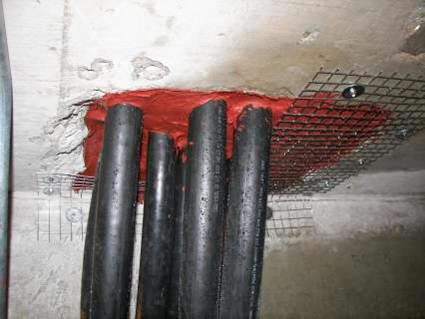
  • firestop mortar:  Cements made from lightweight aggregates, such as vermiculite or perlite, can be used as firestopping. They are typically colored to distinguish them from other types of cement that lack firestopping characteristics. For example, firestopping mortar made by Nelson is colored red, and 3M Fire Barrier Mortar is colored bluish-gray.
  • intumescent:  Any substance that expands as a result of heat exposure is considered an intumescent. Intumscents used as firestops can be made from a variety of flame-retardant materials, such as graphite, hydrates, and sodium silicates. They are especially useful firestopping materials for electrical cables, which can completely melt or burn away in a fire. The expanding intumescent will partially or completely cover the exposed opening created by a melted wire.
  • firestop pillows:  These items contain various flame-retardant and intumescent substances, such as rockwool or graphite. They are filled loosely inside of a fiberglass fabric case that resembles a small pillow. Firestop pillows can be inserted into openings in firewalls and used in conjunction with other firestopping materials.
  • sheet metal
  • fire-rated sheetrock
In summary, firestops are designed to prevent the spread of fire through unprotected openings in rated firewalls. Inspectors should understand what they are and what purpose they serve.